Monday, February 27, 2006

WRITING POEMS AT A PRISON IN NUWEIBA


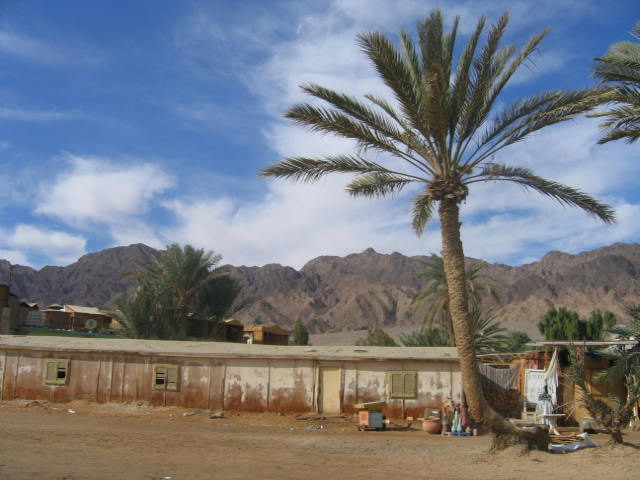
It wasn`t my passion to drive myself off the beaten track that took me to Nuweibas's prision. It was rather a piece of experiment. When the employee of my beach campo stole 15 US dollars (3 days budget) from my bungalow, I decided to take the issue to the nearby police. Unfortunately for me, they must have had their own agreements, since they didn`t pay any attention to my problem. The said I should go the Tourist Police, that was 7 Km. away, but refused to give me a ride even if they had three pick-ups available. We argued and, guess what, the one that ended up in jail was me! Up here you can see my picture, inside Nuweiba's jail. At least I had plenty of time (one night) to give correct ending to several poems...


The ferry that I was eventually able to catch. I had my ticket when unexpectedely confined to prision. And was freed just two hours before departure!


ADANA RE-VISITED


Fotos: 1. "Sex" (real name Mehmet), a friend, and Mustafa. 2. Breakfast at Mesut's flat.

As usual, my hosts in Adan, Southern Turkey were the brothers Mustafa and Mesut, from Hospitality Club. When the bus taking me from Kilisi reached Adana it was past midnight, so I decided to call them the following morning and instead put up my tent. It would have been an easy task hadn’t been for the fact that the steep way out of the motorway here and there only met a 2 meters high fence. Felt like in a zoo. Eventually I found a gap and camped on the other side. Next morning Mesut picked me up from the carpet shop where I had been granted breakfast and phone. Already at his house, a royal style breakfast awaited, as usual!

In the two days I spent in Adana, none of the classics were missing. The BBQ in the inhospitable remote place, for example. The brothers seem to enjoy roasting a chicken or a row of fish in some remote location, behind some moutain or lake. The garden is not enough! The meal was quiet, even if some guys turned up ready to test a Magnum rifle recently bought in the black market fo 80 dollars, and started to shoot the birds over the lake. The other starring feature of Mesut and Mustafa is their drunken friends. The one I met this time was nicknamed “sex” (Mustafa says that’s because he is very good)/ After the third glass of raki Sex starts speaking fluid English, much to my surprise. Talking about surprises, another one was the news that Mustafa and his wife are waiting a new son! I finally departed to Anakara to apply for my Iranian. Pakistani and Afghan visas.

THE TRANSIT FROM EGYPT TO TURKEY. CUSTOM TALES AND HERETIC HARBOURS...


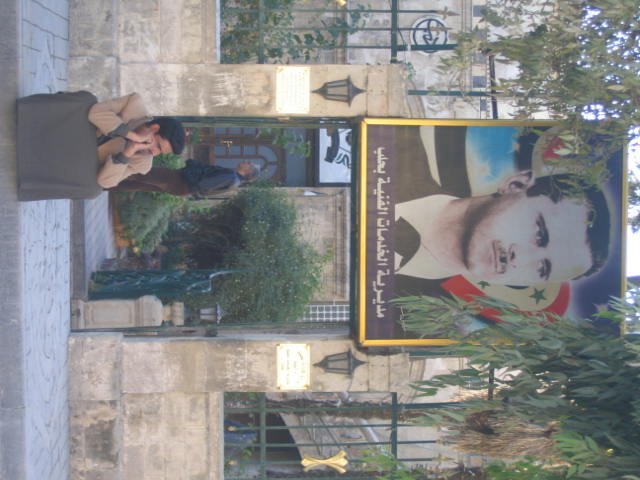
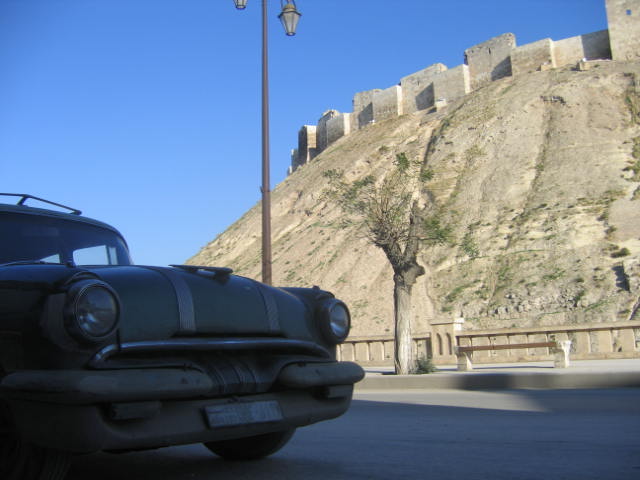
In transit from Egypt to Turkey this time it was only the mundane necessity of getting Iranian and Afghan visas that pushed my sails… The faded portraits of Syrian president Bashar Al Assad marked formally my entry in the country. Not too far from there a sign welcomes me in a way that it leaves no doubt about the democratic caliber of the country: “Welcome to Al Assad’s Syria!”. It is a wonderful morning of wet pavement and cars washed by nature. Even the old Syrian taxis Dodge Coronet (imagine a boat) had received that unjustified shine granted by bad weather to cars that left the show room 40 years ago… The custom officers seem to guess I am a kin philatelist and saturate the page of my passport with nine stamps. They partially cover each other and are obliterated by blue seal that seems designed not be read. Privilege of argentineship: visa on the border after, 20 minutes while-u-wait.


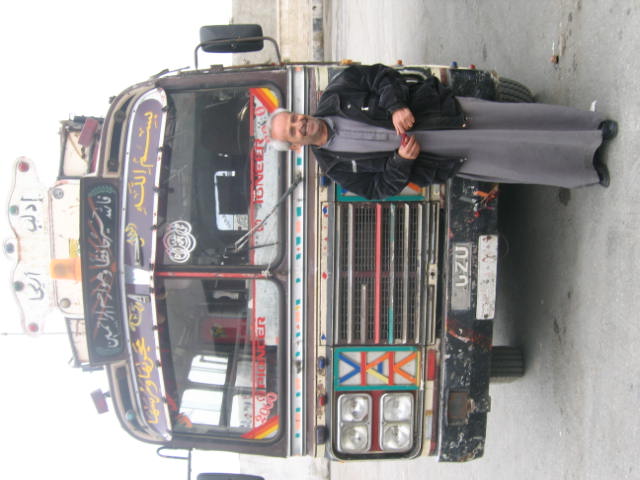
A kebab invited on the roadside by a stranger is enough to put in evidence the Syrian trade mark, in he exact moment in which the vendor, having guessed that I am the hungry one, refuses payment. Syrian trademark is Dignity. I made it to Damascus, the oldest city in the world, in the truck of a man who speaks French. That’s why he knows what autostop means… but he has never seen anybody actually hitchhiking, so proud of being able to match his learned words with reality, he sgives me the lift. In Damascus I stayed two days at Ezzat’s place. All visits to Ezzat end in teologic arguments among the smoke of the argilleh, sometimes making a break to play darts with his brother the jihadman. I was hauled out of Damascus by a 1954 De Soto several meters long, a sublime farewell ride from Syria. I thought I was going straight to Aleppo, near the Turkish border, until being given a lift by a veterinary from Tartous in a Dacia Solenza.

To decide that Tartous was worth the detour it was enough to remember that the old port was the last bastion of the Crusaders in the mainland, back in the 12th C, and also the entrance gate to the yerba mate (argentinian tea also extremely popular among Syrians) in the lugagge of repatriated expats in the 50s. Not every harbour can claim to have seen the Templar Knight going out and the yerba mate sailing in.
Thre is something in which Tartous resembles any other port in the world. As al ports, it manages to oversee the rules, attenuate dogmatisms, lighten clothing and mixing religions. Few women near the beach are happy to wear a scarf over their heads when the temperature in summer goes over 40. The same, shall somebody attempt to explain Tartous seamen, who sail the seven seas, that the beer is anti-islamic. In a country where transgression is seldom forgiven, the tolerance to transgression is transgression itself. It was those seamen who spot me wandering the streets in search of a roof and invited me in their place to share some whisky. One of them had worked on board an Hondurian ship and spoke Spanish. Not need to say, they hosted me, and the following morning I was of northwards as fast a control remote toy car. The destination: Adana, in Southern Turkey, distant 630 kms from Tartous. I was quite sure of being in for a two days trip, since I only stepped in the road at 11 am. Nevertheless, half an hour later I had found a family from tartous driving their Corolla to Aleppo, that’s 50 kms from the Turkish border. As the decisive ride can happen in any moment, I follow the procedure, change the remaining Syrian back to dollars, and turn the unchangeable coins into eatable items (loads of cheap flavourless biscuits) including half kilo o yerba mate, which God knows when I am gonna find again on the shelves.


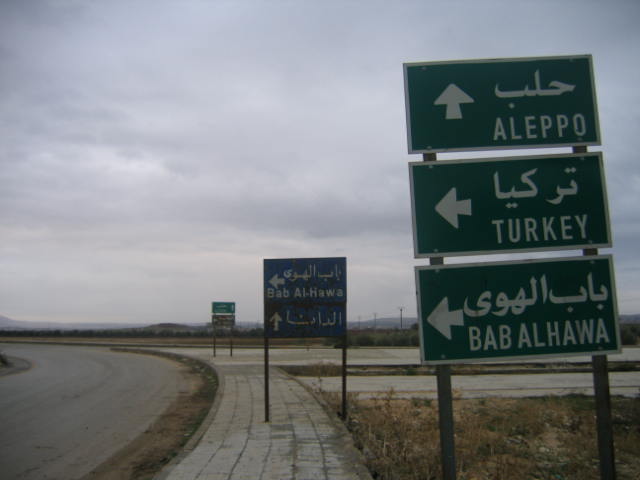
It is already night when I reach the border. When the Syrian custom staff sees me in, they ask me where did I leave my bike. No bike, I explain, I am on foot, and I come from Argentina. It should be written down and archived for posterity that the rankless soldiers in the Turkish-Syrian border prefers “Taragui” yerba to the Amanda one. On the Turkish side the soldiers hold machine guns that at least have triggers, and they gossip about the fun they have when duty allows them to open fire over the heads of Syrian tea and sugar smugglers. As the no one’s land between the two countries they put in a taxi bound for Kilisi, the first Turkish city. Quite predictably. The taxi driver makes his attempt of extortion, and asks for 20 bucks not to let me stranded. In that moment, and corroborating Chomsky’s theories about generative grammar, I discover that my arabic is good enough to say: “Allah is bigger than you” (“Allah is bigger” alone is the phrase which is spit by the minarets of all the world at prayer time, so I just added the final “than you”). The result shows that, unlikely the Egyptians, who can sell their God and their soul for a phone token, the Syrians are ready to loose money in order to preserve their dignity. So the cab driver runs behind me begging me to go back to the car. So the way to Kilisi included this little dramatic play in the middle of the road.
.
From there to Adana it was another 200 kms. At 9 pm, pretty much impossible mission. But then, and even if the Turkish soldiers had warned me about how a hellish place Kilisi was, the first man I ask about the road to Gaziantep is a Kurd who sponsors my bus trip to Gaziantep. A further lucky strike occurs when I discover that the bus goes actually all the way to Ankara via Adana. The driver has no objection with me staying in, ticketless. I made it to Adana past midnight, too late to phone my HC friend Mesut. Some sleepless neighbor may have notice the low blue tent not far from the motorway.

Saturday, February 25, 2006

SIWA: THE GLOBALIZED SANDS.


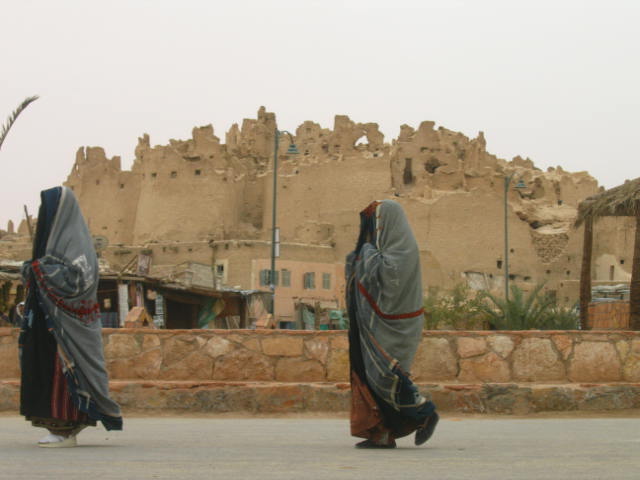
Photos: 1 and 2: siwi women. 3. Mechanical problems in the Sahara.

Many years ago, when the circular tables of the Coratazar Cultural Center at Mar del Plata were circular and centered as petals boiling mind travelers craving to hit the road, any road, then Viqui would say that routine is as sad as a physic map of la Pampa Province. When I started walking south from the Mediterranean city of Marsa Matrouh to Siwa Oasis, inmersed 300 kms in the Sahara desert, I couldn’t less than remember Viqui’s metaphor: the desert is so featureless that the map is all whitness and quadrants organizers of the most absolute nothingness. A red line challenges that void: it’s the road that the government built in 1984 to abreviate to a 4 hours drive what used to be a week long camel trek. Alexander the Great, on his way along the same path to visit the Oracle of Amun in Siwa and confirm his sinship of Zeus, took 8 days for his trip, which according to history was rather uneventful, with the rulers of neighboring Cyrene (present day Lybia) sending him war horses as a present intended to show sympathy and discourage an attack from his behalf.

Exiting Matrouh, evidences of mankind reduce gradually until the Sahara gains all its magnitude. A quarry 40 kms away and some oil fields ahead allow for some traffic and gives pulse to the road. 20 minutes after I set off a quarry bound truck beats the roadside and lifts me. Its driver makes it clear from the beginning that here we are bedouins, in Cairo they are arabs. The next driver were also going to prove good examples of local mind. It was a pick up carrying two sheep, and the drivers were interested in knowing two things: first, if there was rain in my country; second, if there were arabs… The answer: (with rain and without arabs) let him shocked in awe and wondering the requeriments for a visa… It is also interesting to note that, while the bedouins themselves are ethnically arabs, they use the label arab to refer to the settled ones, in opposition to their semi nomadism.

Eaten away the last sandwich, I was only hoping to anchor my tiredness in some inhabited place… A tank truck forward me until the oil fields, where some angel had opened a tea house, where I could buy provisions. The tea house itself is a cubic structure outside which the owner (the angel) smokes shisha. One of the walls calls my attention, there is a giant graffitti of a Nokia mobile phone with realistic details of each numeral key. “Do you sell telephones?” – I asked surprised. No as an answer. I looked inside: biscuits, some bread, tea, final stop. The mural is just decoration, altough I would risk considering it a sort of amulet , icon of the prosper West, an almost magic artifact. The mobile phone is a clear example of the irrational pattern of globalization. The devices have arrived here more as a mandate than as an option, and are seen in hands of people and farmers who should have other priorities. At night the oil digs cheer up in light as tiny Eiffel Towers. I travel now in another truck, we horn to clear the road of camels… In Bir-el-Nuss, a well to which modernity has added a restaurant, I am allowed to sleep. It is midway.

During the morning I make an attempt (failed) to reach Qara Oasis, extremely isolated, 100 kms away from Bir-el-Nuss, which is already in the middle of nowhere. But I am asked for militar permits. Then I continue on to Siwa, contemplating with envy the nylon bags, the only beings to transit freely without documents and at full speed towards Qara. I start to note that I am not Alexander the Great: the Libyans didn’t come to offer me their war horses, and the two crows that showed the good way to Alexander (according to his yellow press paid court poets) must be guiding genuine emperors-to-be. After an hour of walking, and matching the context, a Land Rover stops. A man from Cairo who is building a hotel in Siwa. After a while the Lan Rover starts puffing, sand in the oil bomb, which we dismanteled with the aid of my MSR kitchen tool. As a result we reach Siwa by night.

If asked to describe Siwa, I shuld say that nothing I imagine can resemble more a miracle. After 300 kms of plain desert, of compact emptiness, it is hard to believe my eyes: for kilometers the palm trees don’t leave patch of sand at sight, only interrumtpes by two large blue lakes. On the streets the disbelief rises: people speak not arabic but siwi, a local bereber language. The people don’t look after any other I have ever since, and the are a synthesis of all the peoples that have roamed in the area: algerian bedouins, black people from Sudan, and arabs. Their skin is dark, their forehead high and broad, and finely curly hair. In top of that, one family is composed by blond blue eyed individuals…
Since the construction of the road-umbilical string, Siwa seems doomed to resign slowly its cultural uniqueness in favour of the Nokia and the moods of Cairo, Arabic has replaced Siwi at schools, and tourism rises as a kind of reparation prize, while the government forces the bedouins at neighboring Abu Shrouf village to leave their tents and move to houses. The siwans, however, promise to offer some resistance in this wrestling contest with the global village… Siwa continues to be a highly conservative townn and the few women who venture to the streets covere themselves from head to toe. Often they move in groups, over donkey drown karts. More than women they seem an apparition. The population continues to be divided in 11 tribes, and any new resident must suscribe one fo them. Regardless its curious mix of tradition and change, Siwa can praise itself of being, of all the place he could choose between, the spot where Alexander the Great demanded to be buried. With the sun falling behind the Oracle of Amun, I can consider the trip succesful. Bah… there is not such a thing as a failed trip: each step under the sun is unique and beautiful.

FOLLOWING ALEXANDER THE GREAT’S TREK, AND STUMBLING ON THE WAY.


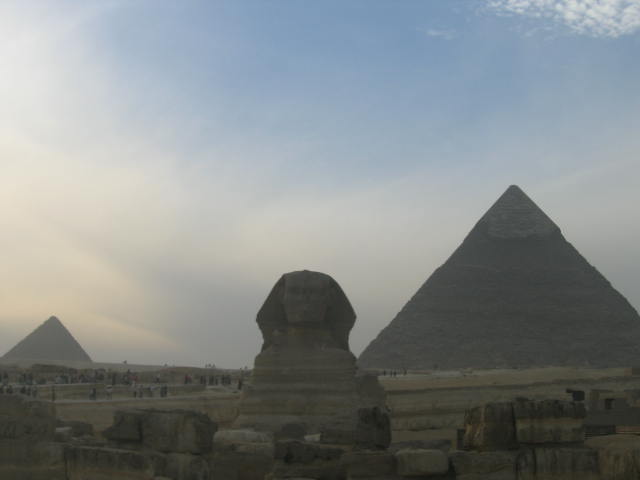
Photos: 1. Pyramids. 2. Kids at SOS Children Village at Al Amria Suburb. 3. Magdy and his cusin, guardians of El Alamein German Militar Cemetery.

The difference is great. Between Alexander the Great and me, I mean. He counted with a 50.000 men strong army. I am alone and traveling by thumb. He strived to forge an empire, I like them only when they crumble down. Maybe motivated by the unoble ambition of having something in common with the Macedonian Star it was that I put the finger on the map over Siwa for the first time. At least this way we would have a route in common. Siwa is an oasis emerging against all possible forecast 300 kms south of the Mediterranean Coast into the sands of the Sahara Desert, not far from the Lybian border. It always owed its fame to being the site of one of the most famous oracles of the Ancient World: the Oracle of Amun, that was believed by the Greeks to be a local manifestation of Zeus. Having taken Egypt from the Persians without fighting, Alexander marched from Memphis magnetized by the fame of the Oracle, anxious to legitimate his sonship of Zeus.

When I left Cairo, the adventure had an operistic oberture when I discovered that the road to Alexandria boasts in its western side not less than the Pyramids. The road to Iskendereia (one feels in the Classic Age when using the local label) was anything but average. First my wallet with 100 dolars was stolen by some impoverished mummy, leaving me with mere 20 cents and 220 kms ahead. 1-0 for Alexander. In such humiliating circumstances a Daewoo stops after only 15 minutes waiting. The driver was a man in his early sixties, spotlessly dress in a suit, while her companion was a woman: 40 years younger than him, thick lips, dark skin and a blue hejab covering her hair. Then the man, becaming a strange statistic case for my road notes, offers me the lady with the only condition of having preferential seat. That’s what I calll to receive 1000 spoons when you need a fork, and it’s only another example (gay truck drivers, etc) of those choices that, repressed by a police force that applies the Qoran, only finds decompression in sealed private spaces and with foreigners. Anyway, 1-1.

On the first night I was hosted and fed by two watchmen that would jump out of their bed with a loaded gun at the minimum noise. On the morning a taxi driver accepted to take me for free to Alexandria, strange event in a country where somebody seems to have swap the Quran for Adam Smiths’s books. “Why not money?” –the man cried and bumped the wheel with his head. He droped me in the suburb of Al Amria. 30 kms from the center. There, a woman that steps down from a motorcycle taxi guides me without my request to a branch of SOS Children Villages. All without words, as obeying a secret choreography of destiny. She is one of the mothers that literally consagrate their lives to raise and educate orphans, from KG to University. She makes me visit each of the houses, 75 children in total. After the visit I could readily say that the village is truly an isle of sanity in the middle the urban chaos that pervades the rest of the suburb, where children work in the vegetable market that smells to donkey’s flatulence.

When I reached the center of Alexandria –in the car of a manager that payed my hotel night-. Looking around I was assaulted by the impression of having been there for ever. I would have never imagined that Alexandria resembled so much Mar del Plata (my city in Argentina). With french style architecture lined against the seaside boulevard conveniently named corniche, horse carriages and cafes that mix in their menu british ale with greek food, Alexandria has allowed the belle epoche a passage to modernity. What reaches the present is an hybrid: elaborated iron street lamps and trams shake hands with shisha bars and local fishermen that knee over the sand at prayer times. The number of foreign consulates in the city attests to its cosmopolitan history, but it also makes you wonder in what does the Slovakian consulate use their time…

When Alexander arrived here he found reportedly a tiny fishing village calle Rhacotis. Over that embrio he ordered the foundation of a big city that would bear his name and would become the greatest center of culture of the Classical World, with the famous Alexandrian Library as its centerpiece, which is said to have contained 500,000 scrolls. In its rooms Euclides proposed his geometry and the circumference of the Earth was first calculated. In the 4th C. the Library was burnt down, in the name of Christianity. Egyptian Authority needed 1700 years before erecting a substitute. The fact that it was inaugurated in 2001 under the government of the dictator –still in power- Mubarak. Also nowadays Egypt just seems the last place on Earth that could natural produce such an offsrping as the replacement fot the famed library. (The average Egyptian cannot read a map) The new library is, in any case, an esthetic triumph: its glassed surface projects a beam of light, including the other local legend, the Lighthouse of Alexandria, which rated among the Seven Wonders of the Old World.

From Alexandria, the way to Siwa. Distant some 600 kms, is made in an “L” movement, as the horse in the chess. It ‘s 300 kms to the west along the Mediterranean Coast until Marsah Matrouh, where the Afrika Korps had their base during WWII. I travel first in a Toyota Corolla of a Egyptian Christian residing in Italy, who presents me a kilo of dates an a weird sacred oil that –he assures- will protect me from the wolves of the desert. The fiirst day I only covered 100 kms, arriving by night to the German at El Alamein, where 4200 soldiers rest. As said by Albert Schweitzer: “There is not a better argument for peace that the tomb of a soldier”. Magdy, member of the bedouin family that guards the mausoleum, allows me to camp outside its walls. The we trade: he offers me bread and cheese and I write a letter in English to somebody called Jean Lucqe in France. Then he asks me why I don’t believe in God. He is brave enough and goes on with an analogy: “If there are 10 people and 8 tell you that certain place is dangerous, do you believe them?” Ontology by consensus, a bedouin masterpiece. I remind him that the 4200 soldiers behind us were also obeying a majority, not to talk about the terror that threads consensus, not to talk aboout Mubarak, the new Faraon of Egypt… The next day I made it to Marsah Matrouh.

Friday, February 24, 2006

CAIRO: NEW YEAR'S EVE IN A 1960 FIAT. "LITHUANIA? WHAT PART OF THE UNIVERSE IS THAT?


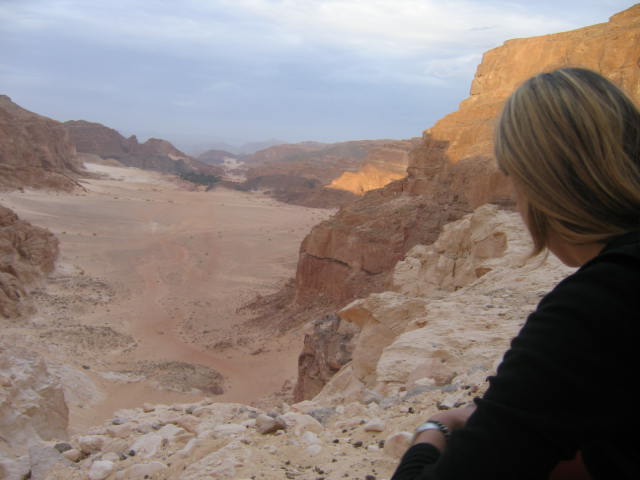
Photos. 1. Pyramids. 2. Ain Hudra Oasis appears suddenly beyond a rocky hill. 3. Unexpected New Year’s Eve with our taxi driver.

Nthe number 400 seemed to much of a superlative to designate the tattered, rusty, shaky bus that was delivering me to Cairo International Airport, where Sigita’s plane would land at 2:10. At the sight of a foreigner in the bus, the ticketman chopped the 25 piastra ticket off with a mix of pride and skepticism. Asked if the bus was going in fact to the airport, the same man raised his hands to heaven and exclaimed: “Imashallah!” (God wanting), which shows how in the Middle East the idea of God is intimately interwoven with lapses of random efficiency.

No less than bus number 400, the way in which Sigita and I had met leads to the search of the threads beyond the puppet, and makes one wonder if things happen for a reason or simply happen. It was an afternoon of the last August. I had crossed that morning the Lithuanian border from Latvia, by hitchhiking as usual, and in the moment I walked along the Green Bridge, the sign bearing the phrase “Aplink Pasauli” was still hanging from my backpack. Admiring the peculiar contrast between the soviet style hammer-in-hand worker ornamenting the gate of the bridge and the towers of the newly built Europa Center behind, I had almost forgotten I was after a supermarket. Sigita was also crossing the bridge on foot, due to a mechanic failure of her Mazda, with the lazy pace that all visit to the dentist should inspire in normal people. Our eyes met for the first time over the question: where is the supermarket?” Now, an old taxi that reproduced with fidelity the sound of an oil generator was driving us to the infamous 2-dollars-a-night pension. In the ground floor of the fin de secle building, a wooden elevator that may have once accomodated french speaking aristocracies now lifted and landed glossy eyed penniless backpackers.

Our room seemed straight out of a Dostoievsky novel. And I say it with all the tenderness that I feel when confronted with sheets where the cigarette holes form constelations. Sigi downed her backpack and started to unpack. It seemed logic to me that the first thing to come out was a bag with fish. The second was a Polish map of Egypt and the third a complete make up set. When her succesful career as graphic designer is not keeping her busy, Sigi ocassionaly poses for the camara. I almost don’t believe her when she says that there are now posters with her picture in downtown Vilnius. That the girl-in-the-picture was gonna end hitchhiking in roads side by side with camel and donkey karts is something that the man-in-the-corner at Vilnius surely ignores. But nothing new for Sigi, who until the age of 12 used to accompany his father –journalist- in his trips around the ex USSR.

In any case, some adjustments needed be made. The fact that our first walk would take place in the most conservative area of Cairo –the Old City- didn’t seem to attenuate the cosmetic powers of Sigi’s make up set. As she was getting prettier with every second, I didn’t have the courage to halt such a promising process with the mundane proposition of: “Hey! This is an islamic country!”. The result was –of course- in the jammed alleys of the bazaar, a massive abandon of Qoran by vendors who lost control of their jaws to exclaim a lascive: “Welcome to Egypt!”. Next time, Sigi rolled a scarf round her neck.

And when is this guy start to talk about the Pyramids? It was an Arabic scholar who said: “All things fear time, but time fear the Pyramids”. We all have a timeless mental image of them, in solemn rest amid endless sands. As a result it comes as a surprise to discover that the Sphynx actually faces the 15 million souls megalopolis. How many millons were born, sweated, and died in front of her eyes? We all should have a Sphynx in our garden to remember the importance of the fugitive moment.

New Year’s Eve took place in a Chinese restaurant. On the way back, our taxi driver could only hit the right address of our hotel after one hour. So at midnight we were opening our cans of Stella in the back seat of a 1960 Fiat, while our drive shoutted out the name of our hotel to passers by with the hope somebody would give him a hint.

Next day we set off for the Sinai, where we started to hitch hike, passing on foot the Egyptian police check points. While hitch hiking in Egypt is in theory illegal, nobody can stop those who declare to be traveling on foot. When the officials read “Lietuvos Pasas” in Sigi’s passport, they ask what part of the universe is that. Somebody with a machine gun suggests that it is a part of Russia.For Sigi, whose parents lived closely the events of January 13, that is pretty much an insult. “Thanks God you are not from Kaliningrad” – I tell her. When my time comes and I say Argentina, the guys recite a list of football players. Diego has become a sort of password. All the same they let us through. Each time. We then visited the sea side paradises of Dahab and Tarabin, where Sigi would say, in a full demostration of Baltic character, that fish, colourful or not, are to eat and not to see behind a diving mask. On the way back to Cairo we crossed the inner desert of Sinai, many times sharing the truck cabin with egyptian workers hitchiking themselves. We stay overnight in Ain Hudra Oasis, where false beduins dedicated to tourism approach us to sell camel rides, while their daughters spy the West trough the shortcut of Sigi’s cosmopolitan magazine.

On January 9th a plane took off from Cairo Intl Airport. Sigi was inside. Time for me to start to investigate how to get iraqi, iranian, pakistani and afghan visas…

Wednesday, January 25, 2006

ON THE WAY TO CAIRO: CLOWN FISH AND MODERN PHARAONS.


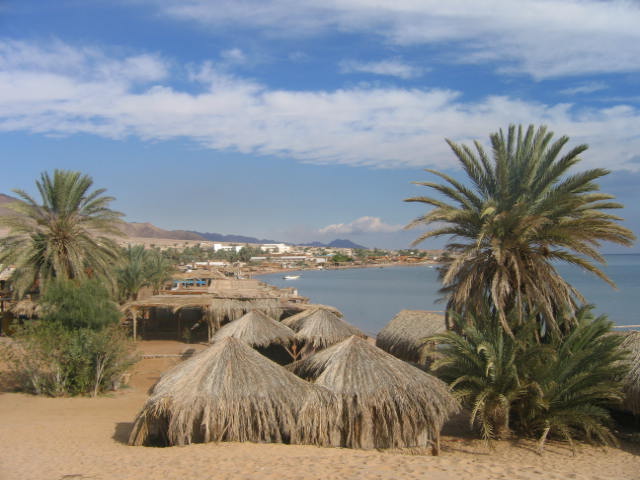
Photos: 1.typic Peugeot 504 taxi (this one was happy to take me for free). 2 and 3: Tarabin.

To visit the ruined city of Petra, in Jordan, I had used my favorite tactic, partially genuine, that of disgusing myself of serious man with a project among hisn hands. Folder under the arm, the glasses that I seldom use and a vocabulary more complicated than necessary helped me to avoid the painful U$S30 ticket. From Petra southwards, the soles of my shoes headed to Cairo. Now, it was not gonna be so easy to dash straight forward through a desert which God used to test his own prophets with temptations and dilemas. In this way, with the sharp cold night enveloping the desert I had to choose wether to sleep inside a truck whose driver hd fallen in love with me or the star clad roof. None of the 7 species of poisonous snakes (not even God) called in for some chat a while and make uo for the length of the night. In any case, the tax was more reasonable than moses one: wandering 40 years in the same desert…

In the Jordanian port of Aqaba I boarded a Sinai boud ferry. Off to Egypt through the Red Sea. All very well known geographic accidents, though rarely we have the chance of linking them with anything else that long since forgoten religion classes. The ferry dropped me in Nuweiba, on of many beach resorts that dot the Sinai coast. I the 5 kms that I walked until finding a lesss touristy spot I could spot, beside camel-riding kids, the dramatic date of the rocky desert and the crystal clear waters of the Red Sea, with its palm tres pinned beach. I had never thought that camels and colour fish could share the same ecosytem.

The quiet beach resort was named Tarabin. The other only foreigners there were a Japanese that had been cycling his way from the land of the Borning Sun, an iraqi nationalized British on his way to spend New Year’s Eve in Baghdad, and one of those German or French families (never American) the do their best to reproduce in their holidays the atmosphere of a Robinsoe Crusoe’s Tale. When I approached to talk, they turned out to be from the Saxon community in Cisnadioara, and my mind blend time back to the sunny days I had spent strolling in the Breite with my Hans and other local friends. December 24 arrived, on of the weirdest 24’s in my life, I spent it around a fire prepeared with a chopped palm tree, talking with the Iraqi guy and a Sudanese, who turned up to sahre with us his melancholic dreams of, some day migrating to the U.S…

On the 25th itself, instead, I decided I deserved some socializing, so I headed for Dahab, popular spot among the hippies in the 60s and 70s, now has just become a trendy beach resort, partly due to the diving industry boom. The Just do it spirit replaced the Let it be. In general, the travellers I met there, mainly Australian and Canadians, didn’t seem to be moved to travel but nothing else but having the finnancial possibility of doing it. At 12 o clock, sorrounded by half Commonwealth, everybody was talking about their proffesional lifes. Eventualy, I was my turn: So what do you do? In these scenarios I feel insanely tempted to declare myself manager of the Umbrella Producing Society of Ulan Bator. While truth would be: freelance lazy, proffesional world wanderer with PhD in roadside walking, proud owner of a 1 Euro account statement… and so on. Beter to go on with the mask of the student until the first whilte hair flowers. And some stopped talking to me. Serious people are irritated when they realized that some people around are just keen on developing nothingness with the vehemence of a conspirator.

On the 26 I wsa back on the road to Cairo, arranging free rides with money asking drivers. It is illegal to hitch hike in Egypt and checkpoints dot all roads. It seems one is arriving to a battle field. In each checkpoint, I smily proclaim that I am walking around the world and hand them my passport. When they read Argentina, conversation turns to Maradona’s health. They tell me to be ware, that snakes and some lawless beduins inhabit the desert, and finaly, after relocating one of the soldiers (machine gun included) in the trunk of the pick up, they give me a short ride themseklves. Night surprises me in the city of Tur, with one of the archs of the tent broken, problem fixed thanks to the tools provided by the local barber’s shop.

The first truck I flagged down on the 27th was going to Suez in one piece. The Suez Channel is sorted by a tunnel. The light glowing in the other side comes from a different continent: Africa. My staying in the continent will be brief and limit itself to Egypt. I made it to Cairo at sunset. With 18 millon souls and its streets shared by happy horn drivers, donkeys and bazaar vendors alike, the city is the most chaotic place I have ever seen. Like a heart, though, it never stops, and even 3 AM is a sitable time to go for a stroll and start bargaining in the street stolls selling anything from trousers to featherful caged chiken. In the hostel were I crush I realize that all travelers have been in the city for several weeks. Some study percusion with local musicians, others Arabic. All excuses to justify the unspecific magnetism that the city provides. Sticking glue under the nomad’s shoes. All stuck like whale in the low tide, victims of a mysterious attachment. A good example is Denny, the Canadian. Running short of money he started to find a way of exporting egyptian watermelons to Canada. In an identic situation an Argentinean would only stretch to perform as Living Statue in the streets… In another aspect I feel a bit ashamed for my fellow travellers who, busy with the Pyramids, they don’t see the current pharaons. President Mubarak has sent to prison a political opponent some time ago, and some timid manifestations happen on the Talat Harb Square. The police, in a psycologic move to display the manifestators as dangerous, were sent to cordon them off as they walked, like a living hand in hand membrana of authoritarism. When the Islamic explorer Ibn Batuta visited the city he penned: “ Cairo, mother of the cities and site of Pharao the tyran”. Not much has change in a country that cannot find its Timisoara.

DAMASCUS: A FIVE LEGGED COW. PETRA AND THE BEDOUIN SECRET.


Photos: 1. Petra. 2. Ali and his father, two fighters. 3. My fisrt saudi driver.
Founded by somebody in some moment of the fifth millenium before Christ, Damascus is the world’s oldest continuosly inhabited city. While its origins get lost in myth, history holds certain that Damascus was the capital of the great Umayyad Caliphat, which comprehended the whole Islamic world between india and Spain, a unity never achieved before or since. From that golden age only architechtural treasures remain. In the Big Mosque, for example, the Mausoleums of both Saladin and John the Baptist find place. One, the biggest enemy of Christiandom, the other in charge of baptizing Christ itself…

To Damascus I arrived after a week of playing Tom and Jerry with the Syrian political police in the Kurdish area. Max, Matteo and Silvia, myItalian friends from Hasakeh, were also visiting the city, and with them I shared my fisrt three days, sneaking into their hotel at night, whose porter was the kind of people that finds a five legged cow perfectly normal. I didn’t count how many times we crossed the covered bazaar, which roof still bears the bullet holes of the French plane’s macine guns trying to sofoccate the 1925’s rebelion, eventualy getting lost in the laberynth of alleys, mosques and Chevrolet Impalas that forges the Old Town.

When the Italians headed back to Damascus I betrayed the hotel (A one leg cow world have certainly called the porter’s attention) and knocked Ezzat’s house door, local member of Hospitality Club. Ezzat is a convinced muslim, and as such he enjoys complicated filosophical arguments. At fisrt he aimed a conversion to Islam but, discovering my agnosticism he tried at least to make me a Christian. “If we can see the caml’s excrement that means that the camel is around” – is bedouin proverb, and Ezzat’s best teosophic card. Leaving religion aside I was fascinated by the way Ezzat’s familiy incarnated contemporary Syrian history. His 86 year old father participated, aged 6, in the 1925 Revolt, smuggling guns in his donkey. With such example it’s no wonder that Ali, Ezzat’s brother, was one of the hundreds of Syrians that rushed to Iraq to fight the American invasion, accomplishing his duty of carrying on the jihad or holy war. The CNN would call him a terrorist. I have him in front of me. He is a calm, educated person, father of three who ownes a metallurgic workshop. He ended up in Tikrit, regreting is militia never saw action: when on April 9th Baghdad surrendered the Iraqi regular troops that had trained them were running in underwear through the streets screaming; “The Americans are coming!”. So, oh surprise, the untrained voluntary militias were the ones no trying to convince the Iraqi army of fighting, gun on one hand, Qoran in the other. All in vain, nobody wil risk his life for U$S100 a month…

Before leaving Syria I stil had a mission, wehich I accomplished on Wednesday: being face to face with the fragnebt containing the oldest known alphabet, coined by the Kingdom of Ugarit, in Syria around 1400 BC. Impossible not to shed a tear, remembering the words of Mercedes Sosa: “Thanks to life, that has given me so much (…) and the alphabet, and with it the words, that I think and declare….” She should have said “thanks to Syria..!”

220 kms separate Damascus from Amman, the Jordanian capital. Of the drivers involved in the trip I should remember an Saudi Arabian in a 1980 Chevrolet Caprice who took me to the border and a Palestinian who in his Toyota pick up smuggled me into the capital and payed (I still didn’t have local currency) a taxi for me to Ala’a s house, local member of Hospitality Club. He introduces his country’ the Hashemite Kingdom of Jordania, apparently conceived in the back seat of a Rolls Royce by Winston Churchill, in an attemt (succesful) of creating a “cushion” state to soften regional tensions. (some say puppet state) It is a formidable contrast that, while the current fronteers have been disegned with a ruler and a pencil by UN cartographers, Jordania encompasses a plurality of Biblic sites. Jesus was baptized where the Jordan river meets the Dead Sea, where I was on Monday. A few kms from there is Mount Nebo, where Moses fisrt received SMS from God promising him the…well…the Promised Land, and sparking two millenia of conflicts. More recently, since the cration of the State of Israel, thousands of Palestinians have sought refuge in Jordan, which was the only country to aknowledg them full citizenship. They are now 70% of the total population of 4 millon. Half of this number dwells in the modern capital Amman, the other half is diseminated in the desert that covers 96% of the national territory. With such geographic parameters one understands that richness can only come from prizes (foreign investments) for the alignation with America. Lula’s proposal of cooperation between the Arab block and Latin America remained unattended, blocked more by the government than by the people.

On Tuesday I headed for petra, the rose red city carved in the mountains that was a secret held for 400 years by bedouins. One day of 1812 the revealed the existence of the secret to a Swiss explorer. I continue walking towards Cairo whre I hope to receive 2006…

Tuesday, January 10, 2006

PLAYING CAT AND MOUSE WITH THE SYRIAN UNINTELLIGENCE.


While international community accuses Syrian Intelligence for the murder of Lebanese ex-prime minister Harari, my own encounters with that disintelligence make me think that it is more likely that Ghandi took Lady Di's life. Up to a moment it was a sum of interviews where I pretended to be an arqueology student and naive looking officers shared their argilleh (water pipe) with me. Even in Ein Diwar, on the Syrian-Iraqi-Turkish border itself, things go quite smoothly. When I am asked for my reasons for visiting the area, I declare my interest for all things old and say I hope to catch a glimpse of the ruined Roman bridge over the Tigris. And so the story satisfied the officers. I am allowed in, understanding Mr Bush's protests that Syrian border controls are not tight enough to fence off jihad fighters caravanning happily to and from Baghdad.

Inspite of this they make me victim of their overwhelming hospitality, which is in fact much more akin to surveillance: firstly, they confiscate temporarily my backpack, securing my return. Walking towards the border I soon find myself chatting with kurdish speaking shepherds, at shouting distance of Turkish watch towers. When I am back they insist in me sleeping on the police station (no thanks) and they give me a ride to Malakya, where I was coming from. This is nothing new for me, I already got used to the fact that everybody wants to know what I do and where I go. The greengrocers asks for my passport and people who would be happy to live in a glass house sneak inside my notebook while writing, extending to me the symbiotic social bonds among them.

It was curiously on my way back to Hasakeh, 150 kms inland from the red zone, where I had already sojourned, where things got worse. Apparently the officers of every town exchanged information on the phone about that week and everybody reported having interrogated the Argentinean arqueology student. While these phones rang I, totally unaware of my recent local fame, was drinking some beer with Silvia, Matteo and Marco, three Italian agronomists working on a cooperative farming project between Syria and Italy. The snack bar, called Venus, is one of the two places in town that sell alcohol, a product only consumed by a christian minority in the area. It is also the most appropriate place where to start a search.
Our conversation was interesting indeed. My friends are an opened book on the local matters. Silvia, who daily interviews dozens of farmers about domestic economy, tells us about the man who headed the enumeration of his property with 200 sheep and finished it with two wives. Then he looked Silvia straight in the eyes and told her: ¨And I am looking for a third one.¨On the contrary, Silvia’s interviews to women farmers ended up with the participation of police officers. How could someone speak with theo sheep without the presence of their husbands? - Police officers and husbands exclaimed. Maybe they had read Orwell and feared a revolution in the farm. While wives do their duties on the field, these husbands spend their time in an activity that Silvia calls Field Watching.

We finished our Jordanian lagers and stepped on the Italian mission's 4WD towards their office to continue drinking. My senses had forgotten such kind of Westner luxury. I refer to the chair and the toilet, and to the Bacardi, that mixed with local Master Cola is, not Cuba Libre, but Saudi Cuba... at most. It was eleven o’clock when the party was over and I was taken to the house of my local contact, in a nearby town. Next morning I would return to use internet.

I couldn’t. Silvia’s voice on the other side of the phone combined anxiety and indignation. It is 9 am and 4 agents of the Political police entered their office to interrogate Silvia, Matteo and Marco. Silvia has to go to the toilet in order to answer my phone call, and it is probable that the phone is pinched. Thanks God almost nobody in these areas understands the dialect of Dante. The agents asked about me, what was I doing last night in their lab and if I had slept there. From the questions it was clear that they had been following me the whole day except for the moment of their nap. At that moment (precisely where it was easier to find it) they lost their track of me. With a little more will they could have solved the mystery. They should have followed the van to my local contact’s house. What is the mistery? If Syrian intelligence wanted to catch me they would have already done so. What mostly irritates them is that I could attempt to start some bonds with Kurdish insurgence. After listening to their questions, I deduced that their fers were fuelled by my appearance in the triple frontier Turkish-Syian-Iraqui, plus the fact that they could not find me in any hotel. How can they pretend to control American spies when they can’t even follow a Latin-American backpacker? Good question!
The Italians and I arranged to meet in Damascus during the weekend and hanged the phone. Meanwhile I had to think of the way of sending last weeks' article and leave the city without revealing my Kurdish freind's identity. In the cyber, the man of the computer next to me watches my screen too much. Through the webcam I can see a brown Nissan Patrol parked outside. I click SEND, I put on my backpack and I go out. The man next to my computer leaves as well, naturally.

This man asks me about my destination and if he can help me. ¨To Deir ez Zor¨. The man doesn't believe that I am going on foot to Deir ez Zor, because it is 180 km away. He believes that I am going to somebody’s house. He offers to come with me to the exit of the city, that is 3 km away, he wants to see me leave with his own eyes, or (he hopes) take note of what door I knock. When we reach the roundabout the unfit plain cloth detective calls it a day, greets me and shifts heels back to town. The roundabout is decorated with a painting that shows the ex-president Hafez raising his hands to the sky while some farmers behind him work as hell. He is the first to do field watching. A few minutes later the man appears again, this time on a brown Nissan Patrol. He offers me a lift. No, thanks. When the Nissan's out of sight I walk far away from the road, spot broad shadowful olive tree and camp under it.

MY BOOTS: MORE LIFE THAN A CAT.


A shoe maker from the bazaar of Deir ez Zor struggles with the Hi-Tech that after 7 months of travelling and a whole previous year, were already asking for an SOS. Those boots were used to go to work while I was living in Belfast. On those cloudy days ( because of that bloody Irish rain) I had a bike without brakes (not to mention that the front wheel was not very straight, so that every little hill was a whole adventure) so I had to use my boots to stop the bike. They, they were used on Argentinian roads, having the most glorious moment when they arrived to Laguna Brava (4230 msnm) in La Rioja. When they arrived to the Sirian dessert the SOS could not be postponed…and for 20 cents of a dollar the man did a reasonable job.

THE KURDS: A CULTURE IN THE CLOSET.


Photos: The road to Hasakeh. Syrian road folklore: tea and Mercedes 1298. The bazaar at Qamishli.

The van from ¨Al Forat Petroleun Co.¨saw me, pressed the brakes, turned around and approached me on the wrong track: a clear example of how traffic in the Middle East works. Three Sirian oil ingeneers were driving the van and... surprise! a man from Colombia, whose sorrows turned up as he confused the next town Mayeedin for Medellin. When we were in town the usual happened: a local english speaking man offered to host me and called his brothers and uncles to stare at the foreigner, and asked him what he thought about Bush. When the foreigner explained his dislike for the latter, everybody raised their thumbs and cheered. In these lands Bush being evil seems to be a universal truth for townmen, donkeys and desert scorpions alike. Up to now, I thought that this could be called anti-imperialism. Soon, I was to figure out that this concept was too broad: as their hate focuses on North America and Israel, Syrians do not seem to worry about the abuses committed inside their own frontiers against other minorities. I am referring to the Kurds, those lazy Indoeuropean people that settled between the Eufrates and the Tigris, instead of walking towards the Mediterranean as their arian peers. Nowadays, there are 40 millons Kurds living in Turkey, Syria, Iran and Irak. They are the biggest stateless ethnic group on earth, not to talk about their basic rights. As I am travelling north from Deir ez Zor, the Syrian Political police seems to be increasing its worry about my presence. The traditional dislike for witnesses...

As these lands are so near Irak, no tourists get here. However, nothing can stop me from entering the area with my backback on my shoulder and a valid visa on my passport. Nevertheless, I am stopped and questioned approximately 3 times in each town. These encounters with Syrian cops can be short as pit-stop, ceremonious with eight officers staring at my passport as if it had fallen from the sky, and always funny: in Margadeh, the officers didn’t stop using their argilleh (water pipe) even when asking for my personal information, with the expected result of being entered on the books as Mr. Mar del Plata (that's my home town) from Villarino (you guessed, that's my name). Another officer, about to collapse for smoking, asked from a corner wich gate I had used to enter Siria. What do I answer to this one?

When I got to Hasakeh, 100 km. north from Deir ez Zor, I bought a limonade and allowed people to approach me. This time I recognized the features of these people: they were Kurds. One man assured that his nephew could speak english well, soon all his family was greeting me. Nazim, my new friend, is a professional history teacher…this would be his profession if he wasn’t one of the three hundred thousand Kurds that can’t work as professional for not having the right documents.

In an attempt to maintain low statistics in comparison to reality, the government do not recognize citizenship to 15% of Kurds. Having to sweat to the bones in his workshop while his title hangs on the wall is only one of the so many humilliations that Nizam has to suffer daily: law also states that he has to be ashamed of his language.

It is almost imposible to avoid the use of Kurd in the streets in areas where this group sometimes covers 90% of the population, but there is a prison sentence if Kurdish is used in official areas. Press, radio, and television in Kurdish are prohibited. The same with poetry and drama. Finally, and most worringly, teaching in this language is also banned. So, a Kurdish teacher has to talk to his 40 Kurdish students in Arabic. I found it terrifying that, beyond the objective damage to Kurds’ proud and hopes, this law banns a whole conception of the universe, that is, a language. ( Maaloula town, instead, is promoted as one of the last towns where Aramean is spoken, Christ’s language. But, of course, Arameans are just a handful and do not live next to oil resources).

While poeple in West Belfast can at least show their colorful Irish flag and call streets and shops using gaelic names, the Kurds from the north of Syria are a ghost nation that can only watch kurd programmes coming from Iraqi channels through satelite TV. In Irak, after the new federal Constitution, the Kurds have won the right to own their own autonomous region. It is not strange that the (low) voice in the streets argues that only an American intervention could change things. (I remind them that there are videos showing Saddam helicopters shooting Kurd soldiers while american F-16 flew over the scene with the order of ¨not to alter the regional balance of power). In Turkey Kurds situation might get better. Not as an example of humanity, but because Turkey, as a prostitute choosing his best costume, tries to like the European Community in order to become one of it’s members some day.

I got to the frontier with Turkey and Irak, where the Tigris runs pacific and out of this world., where the Syrian cops drink mate and watch a Chuck Norris movie. As a prolonged stay might be a problem for my Kurdish friend, he commends me to his relatives. I never stay under the same roof for more than two nights, so I visit the region from cousin to cousin. This is life in a land where globalization means that one person has the right to own a 7710 Nokia but not the right to speak his own language, and where a Yahoo account is more readily available than an ID. I was on the most remote corner of the Syrian Arab Republic, the way back was not going to be uneventful...

Thursday, December 22, 2005

A TEA WITH THE LORDS OF THE DESERT.


In Al Fruglos town, the officers that had hosted me the previous night, sent me in a car to Palmira. ¨Dessert¨ in Arabian is ¨sahara¨, and that is all there as far as one can see. After staring at the vacum of the dessert, one can understand the fact that it was the Arabs who invented number zero...that is, an empty whole as concept. Orange rounded-nose Mercedes trucks roundgo around that vast territory carrying oil. Sometimes, beduin camps or military bases delete the "end-of-the-world¨ effect, till one gets to Palmira.
Palmira has granted a rest to travellers since the times when caravans carrying silk and species from China made a halt at the oasis when going towards the Mediterranean. Its greatness coincided with the Roman colony period, still witnessed by 50 hectareas of ruins, temples and columns as nowhere else in the ex Roman World. The first night I slept in the ruins, in the area where the caravans used to leave their goods, called the Agora. Even though the tent was completelly hidden between two columns, I woke up with four local workers amazed at the view and an Austrian tourist taking pictures to me.
Tourists get no farther than Palmira, but Route 7 is faithful to the dessert until Deir ez Zor, on the Eufrates River, the river that triggered civilization. In 25' a Volvo truck gave me a lift. It was carrying Argentinian corn to Irak. While the truck driver was whispering the Arab song from the stereo as if he were a japanese in the middle of hara-kiri, I remembered the times when when back in my own country I used to travel in ocean-bound trucks carrying that same corn for export. Finally, I can watch the second part of the movie.

My travel book (writen by people who studied but never left Harvard) state that the only possible way to make contact with beduins is through a travelling agency, but reality shows something thoroughly different. The very moment I left the route, they approached me and welcomed me and took me to their tents. The arquetypical beduin has a rifle in his hand- for protection-and a coffe in the other-to offer travellers. Times have changed, and beduins have changed their caravans for their trucks, but hospitality is intact, kicked off by beduins´s dependency on each other while living in the dessert.

Outside our tent, a generator snorrs in the early-dessert night (5 pm), feeding the satelite TV inside. I was told to sit- on the floor, of course- next to the father of 8 brothers of the family. Soon, tea, bread and melted sheep fat were brought. Only after that, we started chatting, in a Arab, so it was very choppy. Sometimes we used drawings to clarify what had been the topic for the previous 5 minutes. Then, they asked me what I was doing, and I told them about my trip. I thought that if beduins did not congrat me for moving in a tent aroud the world, then nobody would ever do it.

So, I was moving around with a tent? They demanded to see the tent inmediately. Hasen got inside the tent and, after ordering his wife to do the same, decided that it was too small for him. The rest of brothers and wives laughed. They asked if I had a family. I told them yes. And, then they said, if i had a family, what the hell I was doing walking in the middle of the Syirian Desert? It was something that they could not understand.

They wanted to know the names of my brothers and sisters, and they repeated them as their tongues allowed them to, calling Fernanda as "Ferlanda", so as not to mention my new brother Casandro. But they were happy repeating "ferlanda, ferlanda" as if they found in that word a mysterious phonetic charm. Beduin families are more jumpy-around than average reserved Syrian families. Their most lively feature are the wives' colorful dresses, who sometimes show facial tatoos.
It is curious, they never made explicit their hospitality towards me. They never said: "Ok, if you wish you can sleep here". That was clear. On the contrary, I was straight forwardt asked to stay for three nights, which were great, forget the father waking up at 5:30 yelling his prayers to Allah.

In the morning I could appreciate the three tents and the truck with which every 6 months they alternate between Hasakeh and the Desert, to feed their sheep. The second day I saw how they made the seat for a donkey, and later visited some other tents. Some of the questions these people asked me left me without a comeback, for instance, how much is a woman in Argentina. And they asked for the price in dollars! They refered to the sum of money that the bride's father must be given before getting married.


Finally I got to Deir ez Zor, just on Friday, when their market is full with colorful beduins that come here to sell their products. The first night I slept in the hospital. Curiosity made doctors forget their duties and prolonged life to the dying that did not want to loose the scene. Then, I went to the only Syrian bank in the area, which was an experience I will never forget. There was a bold employee inserting money in a counting machine. As some baknotes were so torn, they flew away and got to the faces of the client keen on depositing that money. Behind, some women type letters in electric writing machines. Oh! I wold open an account on the bank just to receive a realy and wamheartly typed welcome letter. Now i am going to the bazar, I want to find somebody to sew my boots. After seven months they are starting to show the scars. And the Desert only starts.

Sunday, December 18, 2005

TOWARDS THE DESERT: AMONG TEA CUPS AND MACHINE GUNS.


What I liked the most from Hama, where I camped on the shore of Orontes River for two days, were their norias (the aramean word for waterwheel). They 've on the spot for over 500 years ago, attesting to classical islamic science’s orientation towards complex mechanic. Without much else to see in Hama I travelled towards the Shmamis ruins, a city dating from the 1000 BC, which is 20 km away from Hama through a secondary road. Two workers on a motorbike did not let me get there. They gave me a lift on their heavily loaded motorbikes and we went towards the small town Al Kafar (7 km from my objective) Al Kafar’s simmilarity with other small towns lies in its mosque and the existence of tarturas, a mixture between a van and a motorbike, whose owners insist on decorating with Ferrari adhesives. They are an ode to hope.

It's the differences between Al Kafar and other tiny villages what I was about to discover... As my plan was to camp in the ruins, I was looking for some food to buy. A boy called Hasan demanded that I accepted his help. He was on his motorbike (the second in a day), he ordered me to jump in and speeded towards the market. All the people that had a motorbike followed us, so what got to the market seemed actually like a motorbikers meeting or the funeral of Chips. Then I could not refuse some tea at his house. That was the beginning of the kidnapping.

At the start I did not realice, I was not aware of what was going on Hasan’s sister and a friend stepped into the room, greeted me and sat next to me. None was wearing a veil. At that moment I did not ask any questions. Then I was invited to drink some mate to the house of a family friend. There were two other girls there in the same condition, without a veil and talking to a stranger of the opposite sex (me), Hasan, who was already laughing at my amazement, finally asked me: Do you notice any difference with the rest of Siria?. Yes- I confessed. He explained that the area belongs to Ismaeli minority, a minoritarian sect from the Islam that comprises only 2% of Sirian population. Our Imam, Aga Khan, who lives in Paris, gives us freedom- Hasan explained. They consider that many aspects of the sharia (islamic law) are only aesthetic and therefore not important. Coversely, majoritarian sunni muslims dont regard them as muslims at all.

Their wives do not wear the veil and they can interact with other men without being considered obscene. Even drinking is permitted, as I knew with happiness at night. Hasan entered the room with three cans of Stella. My surprise showed that I had started to get used to the rest of Syria, where women are treated as domestic devices. Shame on me!

However, there is a simmilarity between Ismaelies and the rest of muslims: they are extremelly helpful. Since the moment you eat from our dishes you belong to our family-Hasan said (and he was not joking). I finally left, towards Palmyra, where hundreds of palm trees and massive Roman ruins interrupt the desert.

I was going towards the desert, the legendary Eufrates river. The sign on the road reminds me of something I already knew: “Palmira 160 km, Dair es Zor 380 km, Bagdad 800 km”. Yes, it is the road to Iraq. The first kilometres were on a beautiful De Soto ’54. He left me at night on the Homs crossroad, where a yellow Mercedes 1298 truck rescued me from the claws of darkness. It was carrying 40 tones of bricks. Ahmed, the driver, starts telling the nationality of tank trucks coming on the opposite lane, in the last lights of dawn: Jordan, Syria, Iraq…He left me in Al Fruqlos.

Even though we are far away from the Iraqi border, the area is full with militia. Just in case. When I got down the truck, it was already night and I hardly noticed a hut with three armed policemen. They made me notice them as they approached me with a rifle on one hand and saying “Where are you going?”. I explained that I was walking around the world and that I wanted to sleep in town.

“But it is going to rain”-he answered. My answer was a tiny step under the roof of their hut. They laughed, so they invited me in. Two rifles AK-47 that were on a wall are moved to a bed so as to leave space for my backpack (Good replacement, I thought). When I saw the guns I exclaimed: I am not American!. It is a joke and they understand it. “Where are you from?’-they wondered. At that moment I discovered that on the table there were three mates (Argentinean kind of tea consumed also in Syria). “From there!-I pointed at the mates- "Argentina?”. They are very happy, they offered me a seat and chatted about our countries.

One of them mimics the explosion of a cannon and then of a boy crying, while pointing to the East, towards Irak. He makes reference to the killings of young, innocent children by American bombs. Another one cheers the protests against Bush in Mar del Plata's Summit of the Americas by saying: “Argentina, no Bush, no Bush…”. Despite not sharing a language, too obvious things always get trough. They gave me a place where to sleep and in the morning palmed down a car for me. Towards the desert oasis of Palmira...

Monday, December 12, 2005

ON THE SYRIAN ROADS..


I thought hitch hiking in Syria was gonna be more challenging, with flocks of Hyundai minivan, millions of yelow taxis and less than average private cars. I was wrong. Withn 5 minute something always wil stop. In occassiones cars you wouldn't find elsewhere, 1950 american cars, for example, or motorcycles. This are some examples of what awaits those who dare.

THE PROBLEM OF SYRIA: TOO MUCH KISSING... EBLA: A PARACHUTIST LANDS IN THE ELEMENTARY SCHOOL.


With 9 kms of traditional bazaar where one can buy from flu affected chicken to safety boxes, and a fortified citadel that from the 10th century awaits constant invaders, Aleppo can keep a traveler busy for a week. Nevertheless, it was not the architecture thatbecame that pearl of my sojourn in the city where Abraham milked his famous cow. But the encounter with islamic moral exempted from the secular character that prevails in Turkey.

We are used to listen about the reduced women rights in Middle East. What escapes media attention is that men don’t rake it either. To understand this you should see the face of my friend Hasan when back from a theoric class at the University whre he studies English Translation. “What is wrong, Hasan? Are you feeling OK? Why did you arrive earlier?”. He looks at me and says: “A girl…” “A girl what?” – I ask. So he says it: “She sat nex to me and she was only wearing a T-shirt. What can I do? I cannot marry her. So I left. “ Hasan, as well as my other friend Okbaa, believe that women should hide their charms in order to preserve community. Otherwise, Armageddon. We don’t even talk abouty the Christian principle of “thou will not desire your neighbors’ woman”, here it seems some God gets angry even if you desire yours. In these cases I appreciate christian moral hipocricy, that confronted with a similar holy staements decides to look sidewards. Here instead, they even seem proud of their sacrifice. Hasan is for example 23 and his experience with women is comparable to that of my nephew Nicolas, who is 11. He (tender!) defines himself in the peak of desire (adolescense here lasts until you are 25, if you are lucky) and remarks that in the last two years his girlfriend and him have agreed to hold hands. Pre marriage relations are banned and (you guessed) sex includes kissing.

In these lands uranium is more at hand than a simple summer girlfriend. “But, at University none of them…” I ask in amazment to my friend. But the asnwer again is No. Partying is not in the girls’ top of the rank in a country where Dr.Faustus would die from sadness. “If a girl decides to hace ilegal relations..who will marry her in the future? –my local friends explai to me. That makes me think that men here are at the geometric center of all this social stress. It is a self inflicted pain since the moment that they complain about the unreachableness of girls but then happily say they would return their wife to her father if she turns out to be unvirgin. But..”not even a kiss at closed doors?” I insist to my friend expecting some down to earth answer. His response triggers my laugh: with the worrying a that who talks about the rise of the oil prices he says: “There is much kissing in Syria…” Yeah, the problem of Syria is not Israel or Bush, not even Mehlis, but rebeld kissing students. In any case, they explain that marriage should precede sex, and a good social status should preced marriage, and so much of Syrian youth fin themselves studying medicine or laws, with not a very genuine interest…

All these chats happened in carpet covered rooms, chairless rooms. Everybody finds a place in the cushioned floor. Tea replaces beer. Amid that cultural otherness mate (an argentinian drink I didn’t expect to find here) appears. I almost fell backwards when I saw in Hasan’s kitchen a packet of the same brand I would buy in the shop across the street in my hometown.

From Aleppo I finally travelled south to the ruins of Ebla, one of the cities that triggered western civilization some 6,000 years ago. N the way I am stopped in each village by over-curious syrians that these days rarely see foreigners, and even less on foot. Each of them presents me what they have at hand. The owner of a grocery invites me to help myself from the assortment of fruits. Almost all invite me to halt for a tea and all withouth exception say “welcome to my country!” (their english rarely goes further, and my arab is not even enugh to say that). In the road the few private vehicules stop with readiness. At night people open the door of their houses, where dinners arrive in enormous silver trays. It is costumary to eat without knife and fork, using flat bread as pliers to lift the food, and without individual dishes. A man in the village of Daretazzeh had seen the Summit of the Americas on TV and was completely against Bush’s idea of creating a great and unique bazaar from Canada to South America…or at least that was his way of referring to the Free Trade Agreement.

In Ebla I visited an elementary school, thanks to the food shop owner, who spoke english and even some italian (since in summer he assists and hosts the italian mission that makes research in the ruins) Soon the kids at school spread the news: a parachutist has landed in the schools’ premises. The kids in the class “2 C” are more than happy the parachutist (me) has chosen their class room and approach with some fear to the parachute (my backpack). The girls, with their hair covered by colourful scarfs, occupy half of the right half of the class room, on the other half the boys are minority. Tey assume the parachutist is tired and leave biscuits over my desk. In Irak, the neighbouring country, children must look quite the same, I think. It is very easy to declare and support a war on people whose faces and smiles we don’t see. As usual the virus is on both sides: in the history lesson the kids are told to repeat a patriotic songs commemorating the soldiers who died in the 1973 conflict with Israel. The school book illustrate with full detail the fighter jets and tanks firing their missiles. As usual aslo, the graphic hides the blank of these misiles, the kids in the other side. It is necessary to hide the other side always… if you want to convince somebody to press the missiles’s button. The kids here I can say, don’t deserve missiles. But it’ s a peyy: they have oil under their feet.

Thursday, December 08, 2005

SYRIA: A DEJA VU.


Andre Pavrot, ex- director of the Louvre Museum , used to say: all civilized man has two mother countries: his own and Syria. Syria has to declare as its own inventions in the last 9 thousand years, nothing but agriculture, bronze and the alphabet. (Colleagues writers: it is here where fraud started). Moving in time, and trying to cross the street in Aleppo between hundreds of yellow cabs playing Syria’s national hymn (the blast) one is tempted to think that civilization moved from Syria and never returned. Anyway, Syria is one of the few places where excentric suicidal people can be run over by 404 or a Buick ' 55 without much difficulty.

Getting to Syria from Turkey was to cross a political and cultural boundary. As always, the first impression is just aesthetic: a frontier moved by crowds of people, who proudly show a piece of cloth wrapped on their heads. On the other side, everything that moves and has tyres must be a cab and finding cars that are not cabs is difficult. My first contact with a driver was bizarre. A taxi driver stopped his car on the side of the road, jumped out of the car and exclaimed¨Welcome to Syria!¨(he wanted to sell a trip to Aleppo). ¨Where are you going?¨-he enquired. At that moment a Hudson 50 passes through smoothly disregarding time. I don’t know whether to hitch-hike or pray for a litghning to distroy me..I just claim ¨beautiful!¨, so the taxi driver starts scratching his head showing his ignorance. He didn’t know any city with that name!
When we were in Aleppo, where you can hardly see foreigners, a group of people approaches. We chat: ¨Argentina? Mar del Plata? Oh..thanks for prottesting against Bush, really, thank you...¨I feel proud. In Syria things are not calm at all. It is hard not to glance at the pictures of the president Bashar Al Asad when strolling around the city, usually the president is represented next to his father and the ex-president Hafez Al Asad, who led a totalitarian government for 30 years, installing a presidential dynasty. (not far away from Cafiero).

The current president is focus of international tensions in relations to the murder of the Libanese Hairi, and the main suspect for the international community (that is, for George Bush) is Syrian intelligence. As far as it goes, tensions are improving. Internal support to the president Bashar is growing against every single threat from the White House, with crowds of people in Damasco and Aleppo. As Irak is still being occupied, this is like deja vú. But, cretaing a paralelism would be very courageos .

It is clear that there is oficial propaganda, but it is true that most Syrian people proudly respect their president. The fact that an islamic society and worship to a president can coexist is very strange. Islam is (iconoclasta): there are no human representations in the decorations of Mosques. Islamic art is abstract and geometric, not influenced by leaders and saints.
However, going back in time, we discover that the theory of the divine origin of power appeared in Mesopotamia, so things get clearer. But, what do Syrian people think?

This week I met people from every social stage. Bayan, a sixth-year medicine student, is atheist, and in his efforts to escape islamic close society he thought about the formula that equals America to paradise. He complains about Syrian constitution, which states that ¨the country will be ruled by one political party, which will be led by one man¨. He believes that Syrian intelligence murdered Hariri , though the USA should not be part of this. Bayan hopes to finish his studies in order to get a one-way ticket to any place.

My second hosts were on the other extreme, three literature students who love their president as if he was their father, without criticism. On Wednesday we woke up suddenly: from the streets one could hear the applauses after Bashar´s speech answering to northamerican threats: ¨I am Bashar, I wont give up, and you must know that Syrian people will not give up as well¨. At the very moment, they were broadcasting a hymn-like song composed by distinguished Syrian artists, in favour of their president. My friends proudly translated: Damasco will be a pin in the intrusor´s eye¨.

The most interesting of my new friends is Okbaa. He is intelligent and sensitive, he also studies medicine, and is member of The Sirian Social National Party. The party was founded by a Libanese called Saadi, who was expatriated for 30 years to Argentina and Brazil before coming back in the 40’s promoting an ideal union of Great Syria. Saadi-just as Okbaa-thinks that Siria, Lebon, Jordan and Irak are the same civilazation, artificialy divided after english-french coloniaism. According to Okbaa, Hariri is the USA´s Troyan horse in Siria. A am amazed when my firiend tells me that, in case there was an American invasion he would not turn on the TV, he would get a rifle. Okbaa believes that his young president Bashar will lead the path to a modern, multi-party, democratic Syria.

There is something that is clear, people in Syria believe they can find their own way to a true democracy. I don't really think that is close to happen. Any way, nobody believes that democracy will come on top of American tanks. About Bashar: though he is a bit demagogic, he is not like Saddam, who sleeps with his gun under the pillow. He is a professional oftalmologist, and used to work in a clinic in England before he became president.

ADANA AND THE SENSE OF RAMADAN


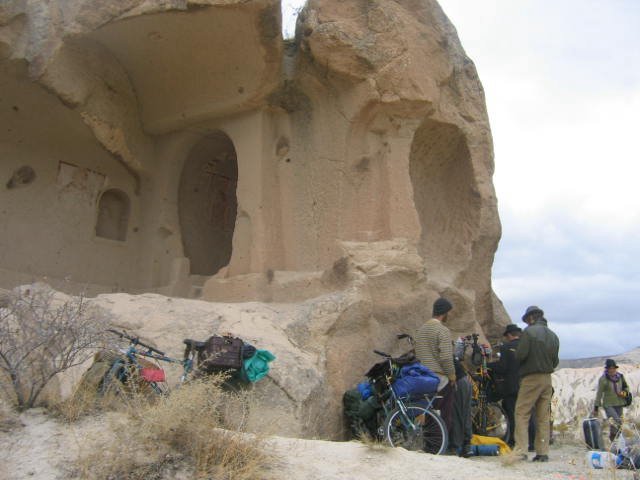
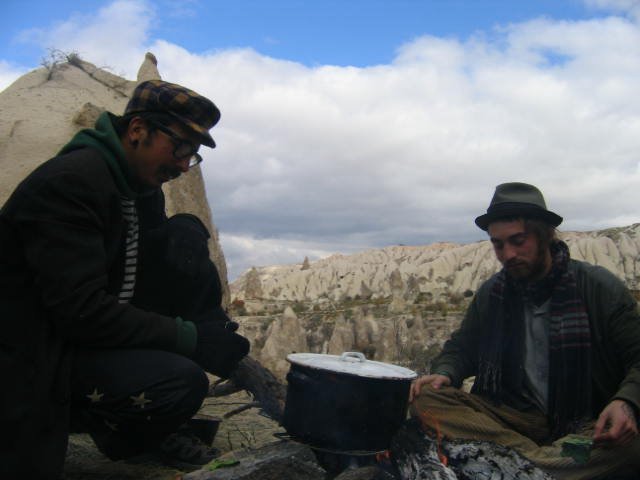
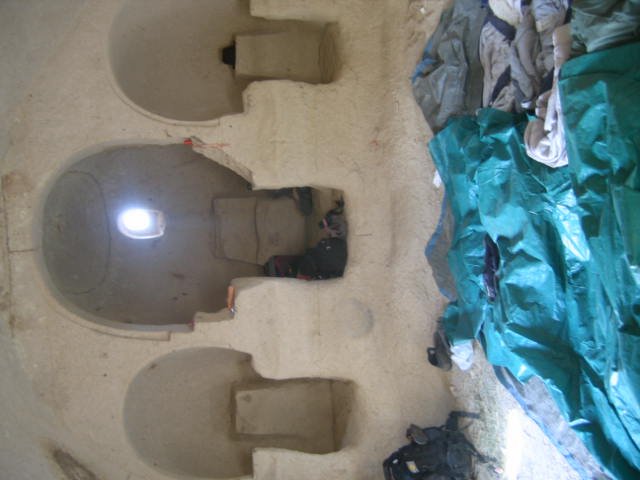
After living in a cave in Capadoccia the Oracle of the road suggested I deserved to treat myself to great hospitality of Mustafa and Masut, Hospitality Club members in Adana, Turkey. Their natural kindness was enhanced those days by the fact that we were in the last days of Ramadan. I honestly lost the count of the number of uncles and cousins we visited, and I think it was the first time in this trip that I gained weight instead of loosing it. Having breakfast in the top floor balcony of Masut luxurious appartment facing the lake I frankly asked myself if I hadn’t been mistakened for a Kuwaiti sheik. Maybe I did these guys some favour in a past life. Not happy with feeding me to the red line point, they decided to dress me and presented me with jeans, sweaters and T shirts that my budget would have never been up for. Maybe the most special moment (and funny) was attending the mosque on the Bayran day (the last of Ramadan) following a suggestion by Mustafa who said I should just imitate his moves. Obviously I did everything wrong! Outside the mosque, Mustafa explained me the sense of Ramadan. Festing as a way to appreciate things that we would otherwise take for granted. Quite like hitch hiking. One week in a cave in Capadoccia before landing in the oppulence of these brothers’ hospitality.

BICICLET... COK GUZEL! (BIKE CIRCUS IN CAPADOCCIA)


As if the surreal Capadoccia’s landscape was not enough I was still to meet its most particular inhabitants... The place, an area in Central Turkey where erosion produced by the wind and rains in the last million years has built improbable contours in solidified lava. Most of them are cones, which look like melted ice-cream from the distance. Proffiting from the smooth substance, humans have dug their houses on the rock and the first Christians founded monasteries. Bizantine churches are found dug in the ¨tufa¨, even showing paintings on the walls. While I was exploring the area I saw nails flying . Somebody was doing malabares and listening to music. I climbed to the caves to check who were those people…and there it was, the Bike Circus. They are 9. Four Americans, (the Texan Chanin plays the bandoneon, the one of New Orleans the contrabass, another one the flute and the last handles the violin) two Italian (Piero and Simone, one looks like Mario Bross, I swear it, the one who plays the Tablao. The other is drawing all the time and addressing his partner as ¨stupid italian¨), a Canadian from Quebec (Marie Elise, violinist, gymnastic, with a J.Joplin-like voice, the one with a red seal on her passport banning her from entering Europe for I-don’t know-how many years.) a German (guitar) and the last member… ...When I got to the group the last member was walking over her hands inside one of the carved-in-the-mountain devastated chapels where one can still distinguish the arcs and altars . I was wondering where she was from when she started singing: 'Voy caminando por el aire'...... Where are you from? Can you believe the fact the Rocio was from Ramos Mejia (Argentina)? After a long hug, the first thing we asked each other was ¨ Che, do you have yerba? (local tea)'' She has also been looking for it in Istambul’s bazaar without any luck. There, vendors attempt to sell her a strange kind of black grass that had scared her and, of course, a carpet. The Bike Circus goes around the routes with their, sorry to be obvious and repetitive, bikes. But they are special bikes. They are a meter fifty high and have two verticaly welded frames. Once, a Turkish policeman stopped them to check on the phone with his boss if that type of means of tranport is able to circulate around theTurkish highways. They perform their circus-like music show in the towns and then, they go on travelling. The substance of their trip is beyond each of them as individual travelersi, since some of them joined the group on the road, while others left it. Any way, they are an ode to movement. Rocio lost her Argentinian accent after so much wandering. (Those things the passport can not account for). One time she asked me : ' How do you call what is inside a peach?' ' Cob!' (¨carozo¨in Spanish) I answered angrily.... Rocio plays the drums and sings flamenco while she dances chamame. Then she tells her audience she is Japanese. It is crystal clear to everybody! There are two signs hanging from her bike (in the middle of her provisions and briefcases). These posters are about two different problematics. The first one says ' Cycling against Oil Wars'. Everybody understands it. The second is more related to her neighbourhood and says: ' We are all teachers. Ctera.' (Argentinean Trade Union) Although I had already found a place to sleep in Goreme, where we were, a town almost totally built on the rocks, I decided to move to the caves with them. It is not an everyday experience to occupy a bizantine church from the 10th Century, with its very own fresco on the wall…. Inside, they discuss the following step to follow.... the Turkish visa of one of them is about to expire, it is necessary to leave and return , so they spoke about hitch-hiking to Bulgaria and back. But, before that, they decide to go to Mersin, a town in the Mediterrenean Coast, where winter is smoother (here it already started to snow). This way, I join the circus for some days, I am also going south.... A scribbled Jesus is trapped in a painting and from the door he stares the scene and he does not add anything. In the morning, lunch is cooked, with one of the prettiest landscape I have ever seen. On the while, the dog, who has joined the group since Serbia, warns us about the presence of an Australian tourist in search of a picture with the us, the colorful loonies...

SQUATTING RELICS!!


Here some of the piucs of the Byzantine church carved in the rock, where we slept. Also the fire place and the frescoed wall of our "room". Not everyday once has the chance of squatting a relic!!