Saturday, March 25, 2006

A FLEA “TRASH” MARKET IN ARBIL


Beyond the concept of “second hand”…

Friday, March 24, 2006

SECRET BEAUTY OF THE KURDISH COUNTRYSIDE


Yeah, I know. We believe it is only about desert and manoeuvring American tanks.

Thursday, March 23, 2006

HITCH-HIKING FROM BARZAN TO ERBIL: THE DRIVERS


A car mechanic who had lived in Munich and spoke good German.


Two local soldiers. In the beginning the ride was for free, 10 km later I had to pay, and then it was for free again…

Tuesday, March 21, 2006

FROM HOMELESS TO FRIEND OF THE ROYALTY: MEETING SERBEST BARZANI


Notice: to read the full story, have a look at my book “Vagabonding in the Axis of Evil – By thumb in Iraq, Iran and Afghanistan”. Clic here to learn more. Order a copy and keep me on the road!
As usual, peak experiences take place in involuntary detours, in those coordinates of the map completely lateral to our original destination. In that way, the following morning I was early on the road pretty sure I was going to Arbil, only to stumble 10 km further up the road with a library sponsored by Lovebridge, a German foundation, befriend its director and accepts his invitation to spend the night with his family back in Barzan.


Serbest shows me around the whole building opening all doors ahead as if I had some kind of allergy to handles. If by mistake he fails to give me priority to pass he apologizes: "Sorry Mister Juan!" He walks stopping briefly at each shelf to name its content with elfic manners. In the main reading room it’s obvious we have interrupted the two employee’s chit chat. Who can blame them? There is nobody consulting any of the 10,000 volumes that rather seem to be aging as wine in a cellar.


In top of one of the bookcases there's a poorly stuffed duck, his wings extended for nothing ("He came from Iran" -proclaims Serbest") and a street dog, surprisingly stuffed by somebody with an urgent need to stuff but little range to choose from. So, as she shares the fate of the pharaohs the ugly dog shows his teeth to everyone on the room. Nice invitation to reading. Serbest insists on extending the tour to a large classroom where two foreign aid workers teach first grade schoolboys according to Montessori's postulates. But it's him who has become the focus of my interest.


Serbest's house stands on a hill, some 200 meters from the "maker" where I had slept the day before. While his wife's shadow brings the tea tray as close as the culture allows her, Serbest's mobile rang. He glances at the screen and smiles when recognizing the number. "Takk!" -he answers. Conversation follows in a German like language that sounds familiar but that I cannot identify. It turns out that Serbest, who speaks broken English, is proud fluent Danish speaker. Exile is again the Rosetta stone for the matter: five years of political exile in Copenhagen. On the other phone, Maher speaking, who is not in Denmark, as one would expect, but in Arbil a hundred kilometers away. In the land of the butter cookies, Maher and Serbest were co-exiles and pals.


When asked about the reasons of the exile, he stands up and hangs down a family photograph from the wall. From the twenty people (all men) posing staunchly in regional dress I only spot one, the ubiquitous Mustafa Barzani. Serbest's finger rests one second in each face before moving on, just the time it takes Serbest to pronounce the sentence: "Assassinated by Saddam."
From the confusing genealogic explanation it followed that Serbest, whose surname is also Barzani, came to be something as the cousin of Mesut Barzani, the president of Kurdistan. Although I have the feeling the surname is more of a load to him tan a privilege, it's no doubt he would have joined the list. It is also clear that repatriated exiled make up a significant sector of Kurdish demographics. Somehow, everything in Kurdistan is returning: the Pesh are back from their outlaw life in the mountains and political refugees fly back from the Scandinavian welfare states to take their places in the construction of the dream. An implosion follows each exodus. The recent addition of a weekly flight from the Danish capital to Arbil suggests this is not just easy talking.

When dinner arrives I hardly have any appetite, we have been talking about the Anfals operation, when Saddam choppers attacked Kurdish villages with lethal gas, and about how Arab and Kurdish refugees transported their mutual territorial exclusion to the temporarily camp in Denmark where they all waited for the approval to their asylum request. With all he lived, it surprises me how calmly Serbest speaks. It seems he is reading a bedtime story. Muslim by context, Serbest appears to my eyes as a nihilist. Behind the mask of the local turbaned man unveils the profile of the universal man who even drops a Krishnamurti thought:- Oh, Mister Juan! Maybe you are thinking in what are you going to do next week, or when you arrive to your country, but when you stop thinking, only then the whole world will be there.And it was as if my vertebrae would crack.

Monday, March 20, 2006

SERBEST AND THECANYON OF THE IBEXES


Serbest proudly shows me a canyon populated by jumping ibexes....


Serbest and his son.

Saturday, March 18, 2006

IN THE COUNTRY THAT ATTEMPTS EXISTING...


Notice: to read the full story, have a look at my book “Vagabonding in the Axis of Evil – By thumb in Iraq, Iran and Afghanistan”. Clic here to learn more. Order a copy and keep me on the road!


An elderly bunch plays "dama" over a board drawn with chalk in the pavement, with movements that combine gentleness and velocity. We are not far from the bridge that, has granted way over the river Zakho, for near a millennia in the town of the same name. A black and white turban caracoles around their head as a Babel Tower. It is an exclusive pattern, like a plate number, and it indicates the men are from the North Eastern Mountains. They play with stones rhythmically; it seems they are trying to attune history.


I am in the Iraqi Kurdistan, and so much calm here is as foreigner as I am. For the first time, what is apparently sliding irreparably into civil war is the rest of the country. Even if since the end of the first Gulf War Saddam's helicopters haven't raided the region unleashing lethal gas, only for three years the Kurds have been able to relax and play "dama". The fringe of a large and gloomy cloud obscures the sun. One of the men stands up and exclaims: "Stormy weather is coming from Iraq". Given the fact that, at least technically, the conversation is taking place in Iraq, the comment is not a mere weather forecast, but -and specially- in front of a foreigner, a proud declaration of independence. In the mast of a nearby school, the Kurdish flag supports the comment.


I changed ten dollars to Iraqi dinars and hit the road without more plans than advancing trough the mountain road network towards Arbil, the capital of the Kurdish Autonomous Region of Iraq. My map, with its designs of miniature camels in the Eastern Deserts and oilfields in the Persian Gulf area, caters more for getting school boys interested into geography lessons than to guide a foreigner in the aftermath of the war. I don't either the least reference about the local reaction to hitch hikers.


Happily, as I am still walking in the outskirts of Zakho, and only after two minutes waiting, a spotless Chrysler Concorde stops. Surprise wrests heavier than the lack of habit it seems. I get in it astonished; it is not the kind of car you would expect to stop in a country that counts 20 years of internal and external conflicts. In spite of prejudices, the average car in Kurdistan is a 1991 Opel Vectra. Not bad, Syrians are still driving their 1950s De Soto and 304 Peugeots... The driver is a barber, and he speaks fluent German as a consequence of exile. He drops me in the highway to Mosul, which has been strongly advised against. It seems I am forced to take it for at least 50 km. As tango philosophy goes: "If you are already in the dance floor you must dance". Well, I didn't come to Iraq to take dance lessons, but there were no options, so there in the Mosul highway I extended my thumb.


Two minutes again, a Peshmerga (Police) commander slows down his Mazda (freezing traffic for one minute) and welcomes me in. He is driving to Duhok, a middle size town considered safe from where I can finally connect with the mountain network. Despite my driver is a policeman, the local Pesh stop me for questioning and examine my passport suspiciously before waving me through. To the inherent difficulty of explaining that one finds attractive the panorama of hitch hiking in countries bordering collapse you must add the bonus of having to explain it in Arabic (The only channel of communication since I don't speak Arabic). The most annoying thing of roadside questionings is that after you are let in peace there is always another curious gun-totting official at the exit of the next town.

So in Duhok itself I was stopped again by the Pesh that, not understanding why did I want to palm down cars as I walk when I could just charter a taxi from the city center, they propose the military version: a soldier with a Kalashnikov stops the first car, opens the door and orders me to jump in, and takes seat at my side.


I travel with armed escort until the village of Zawita, when the soldier (I must say he was of the smiley type) gets down and pays both his fare and mine. I am already in the mountain road. By a petrol station, a lieutenant of the Peshmerga pulls aside. I am tempted to think that, either the security forces are extremely kind, or all the population holds a position in them. (With time I would consider realistic the second option). My driver's name is Memet, who changes gears and listens to electronic music as he speeds by the sinuous road. The alpine like landscape conjures up an aesthetic illusion, for a second I think this is Tirol... The lieutenant himself doesn't seem to have a much accurate idea of where we are and, maybe conditioned by history, he asks: "So... is Irak beautiful? I mean Kurdistan!" He laughs at himself as the first rain drops predicted by the senior dama players of Zakho come true.


When we reach a village called Barzan he takes another direction. It is too rainy to make travel pleasant so I decide to stay there for the night. Memet says I should have no problems finding shelter in the "maker". I didn't know what a maker was, and as Memet's explanation in Arabic didn't help, I decided to walk up hill following his index finger in search of... well, in search of a "maker". At the sight of the only official looking installation I knock the door, which was opened.


Two men were drinking tea in the large carpeted room only whose squareness was only interrupted by the large heating stove vertical pipe. They stand up with one movement and, as if they had been waiting for me, they made place in the ritual for me. A banner of the KDP (Democratic Party of Kurdistan, hangs from the wall. Only a day after I would understand that I was in the base of the Peshmerga who look after the grave of Mustafa Barzani, leader of the Kurdish Guerrilla that confronted Saddam. As the surname indicates, Barzani was original from Barzan village. Unwillingly, and forced by the rain, I had hit the spiritual center of Kurdistan, as anybody who sees the hundreds of flag decorated cars in weekend pilgrimage-picnic to the site may agree to call.


This Pesh, unlike the ones in the checkpoints, execute a verbless hospitality. They are not interested in my passport or destination, they simply like to help. During the dinner, down in the floor around a giant circular tray, the TV displays home videos in which columns of Pesh triumphally trek down the Shirin Mountains after Saddam was defeated in the first Gulf War. In March, when most of the Kurdish national days (Anniversary of Barzani's death, Declaration of Autonomy, etc) seem to happen, such imaginary is so profuse that you think the good men are still descending, happy and muddy. Provided each fighter has grasped some wisdom during his sojourn in the heights, as Zarathustra did, there is no doubt we are witnessing the rise of an enlightened nation.

Tuesday, March 14, 2006

HITCH-HIKING TO IRAQI KURDISTAN: SORRY MISTER...ARE YOU A TERRORIST? OH SORRY! I MEAN....A TOURIST?


Notice: to read the full story, have a look at my book “Vagabonding in the Axis of Evil – By thumb in Iraq, Iran and Afghanistan”. Clic here to learn more. Order a copy and keep me on the road!
.
Bernard Shaw once penned that martyrdom is the shortest way to fame. I cannot say, though, that I am driven by any masochist quest to trespass fire lines. There isn't either any necessity to cross Iraqi territory in my otherwise natural passage from Turkey to Iran. If something took me here, that was the loyalty to the idea that caused me to hit the road on May 1st, 2005: human being is intrinsically good stock. It's been more than 10 months since I let my native Argentina and started my walk from Belfast City, in Northern Ireland, with my stuffed backpack and my thumb ready, committed to roam Europe and Asia, not as a tourist, but as a wanderer. No credit card, no mobile phone, no hotel bookings, no buses. No plans. Hitch hiking, my only mean of transportation. Cheap, that's true, but mainly a secret gate to the harmony of chaos, a chance for advancing without imposing, abandoning oneself to the involuntary punctuation of the road that builds itself.

Behind the expedition one aim: to compensate the partial and stereotyped picture of the world generated by mainstream media by portraying universal hospitality across the globe. Official image of the world, centered in the political conflicts among governments, outframes the basic honesty of the average man struggling under any flag, fomenting thus the paranoia that grants ground for further conflicts.Since I left Belfast I haven't found a country whose people is not convinced that hell starts in the neighboring country. The Hungarians swore that I would be eaten alive by Romanian Gypsies, while in Romania those Gypsies warned me, as they obliged me to drink their ziuca, about the great danger involved in crossing the Bulgarian border. Of course Bulgarians would rather grant me citizenship than letting me trot into the wild Muslim world. So each time I would get a new stamp in my passport I would tell myself: "Ok, here is where I am going to be effectively thrown to the hungry dogs". Only to have my expectations frustrated by a bunch of jumpy-around locals inviting me to their homes. Now it is the Turks who fear for my integrity as I hitch trough their country in my way to Iraq, the famed homeland of the kidnapping art, even if I am going to the relatively safe North.


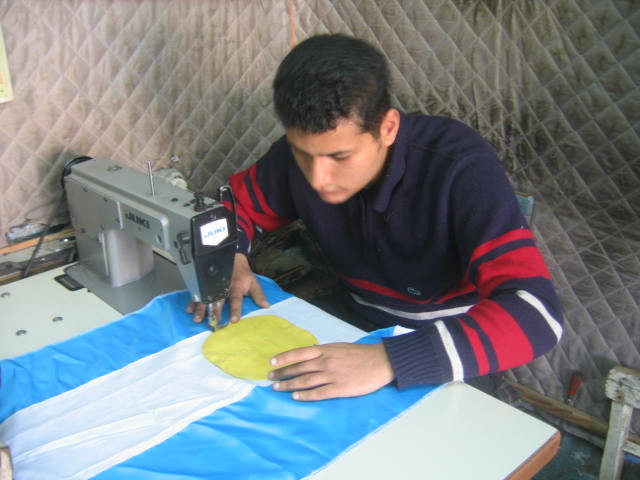
The distance between Europe and Iraq is more symbolic than geographic. Even if the chaos with which the country is constantly linked with seems incompatible with proximity, let us remember that Iraq will have a full border with the European Union as soon as Turkey is blended in the joint. Hitch hiking swiftly from Ankara to the Southeastern provinces I am driven in fact a highway that bears –or drags- the European standard road nomenclature E-90 until the very border , always failing to signpost Iraq at all, as if shameful of its destination. Across intensely green grasslands guarded by still snowcapped mountains I bypass the cities of Sanliurfa and Batman. In Sanliurfa, the tailors receive the most unusual instructions in their lifetime, namely to produce somehow an Argentinean flag to hang from my backpack. If I happen to stumble upon fundamentalists, hope they see from the distance I am a South American. Holding also an Italian passport I deposit it in Batman Town Hall (as ridiculous as it may sound). I reach Silopi, the last Turkish town, in a yellow Scania whose driver declares how much he likes me. And strategically removes the news in the dial and tunes some romantic music. The episode hardly matches the circumstance of arriving the tricky border.
.
But border are we exactly talking about? Is there a border? If I believe the map I should say I am crossing from Turkey into Iraq. That's officialdom. Reality: the last "Turkish" guy I talked to (he halted me in the streets of Silopi and forced me to accept his invitation to drink lemonade) welcomed me to the Mesopotamia, and finally wished me good trip to Southern Kurdistan. In this case, if you want to update your lingo, you have better get back t the times of Ramses II. Despite having mastered the mountain passes among present day Turkey, Iran, Iraq and Syria, the Kurdish people have never been able (or allowed to) established their own state, becoming the largest ethnic group worldwide without one. Nevertheless, they brokenheartedly refer to every patch of land they inhabit as Kurdistan, and still denounce the Treaty of Sevres (1920), in which the triumphant Allies granted freedom to other victims of the Ottoman Empire, such as the Armenians, but never consolidated the sovereignty promised to the Kurds. The fact that oil hides underground may have something to do…
.
What decades of hiding in the mountains grenade propeller in hand didn't reward the Kurds just fell from heaven when Saddam was elbowed out in 2003 by the Coalition Forces. Since then, the pompously titled Kurdish Autonomous Region began to consolidate itself as a truly independent republic, even if still tied to the national capital Baghdad. And so the wind caused yet another flag to wave: the Kurdish Flag, which suddenly came out of all closets. The Peshmerga, (or simply Pesh), mountain partisans under command of local hero Barzani, also trekked down the mountains to become a full legal nation wide police force. Just imagine one day IRA forces patrolling the streets of Belfast and Londonderry.
.
"Welcome to the Iraqi Kurdish Autonomous Region"- announces a sign in the checkpoint. The kind man behind the glass takes my passport with some surprise... "Argentina? Maradona!" Until then he is sadly average. But then adds a striking: "Are you a terrorist, sorry...oh no Mister! I mean...are you a tourist? I was starting to think that the Kurdish Democratic Party in charge was democratic to the extent of having a tick box for every path of life… In shameless opposition to the Iraqi embassies in Ankara or Cairo who had asked me for a special visa costing 50 bucks and taking three weeks to process, these folks just ask me: 'So why are you coming to Kurdistan?" "Well – I answered naively- you are a new country and I wanted to visit you." I also let them know I had visited the Syrian Occupied Kurdistan and gave the Kurdish names of the towns. After that, they became the most accommodating guys you could think of, stamped my passport and waved my trough. I was in.
.
I thought I was able of such arrogances only in inoffensive countries like Slovenia or Latvia. But instead I found myself stepping into Iraq at night, without local currency and with a crappy map downloaded from the internet. With what moral authority I am going to tell my children not to throw fireworks to the neighbor's dog? I entered the first roadside restaurant I met to examine my map, and there the image of a U.S. contractor taking his food tray to the table fully dressed in Marine uniform took me to reality, I was in Iraq, I should watch my step. Convincing the opportunist taxi driver that I didn't owe him 20 dollars just for hauling me the 2 kms between the two border posts had been impossible to the point of letting him speaking alone to his old Renault 12. When I exited the restaurant he was there again, accompanied by a police officer. He wanted his money, but it was not his day, the policeman was more interested in knowing the countries I had seen in my journey and told the driver not to bother me again.
.
An early impression of Zakho, the first Kurdish town, was that of a lack of balance. Cars luxurious even by European standards (read BMW X-5, Chrysler Concorde) jam the main street aligned with decrepit shops and very basic housing, Kurdish flags equally decorating crumbling houses and expensive toys. Of course, it was too soon to understand anything.
.
As I walk in search of a cheap pension, the crowd that chews kebab under a portrait of a head robbed Barzani stare at me as if I were a green dog. Just think the country hasn't seen a tourist in the last 25 years. So visible, the security forces promptly entered the 2-dollars-a-day room I was sharing with three workers from Mosul, and did the usual questions. The usual questions didn't include what I am sure they were asking themselves: what is a foreigner doing outside the Hilton? Even if it is the language of the enemy here, they seem to appreciate that I speak some Arabic, although they left the place offended because I had refused to sell them my tent. Both the workers and the officials advised me against visiting Mosul, Tikrit or Baghdad. Their reason, let aside the daily car bomb in Baghdad, is more quintessential: "People there is Arab" –he sentences. Of course, hell is a plant that grows on the other side of the fence…


In the morning I peep through the window. The Kurdish tricolor is waving outside, the green, the red and the golden sun in the intermediate white stripe contrasting bravely with the gloomy, cloudy sky. The heart beats. Ready to attempt hitch hiking in a country that attempts existing.

BREAD ECLIPSE... and more.


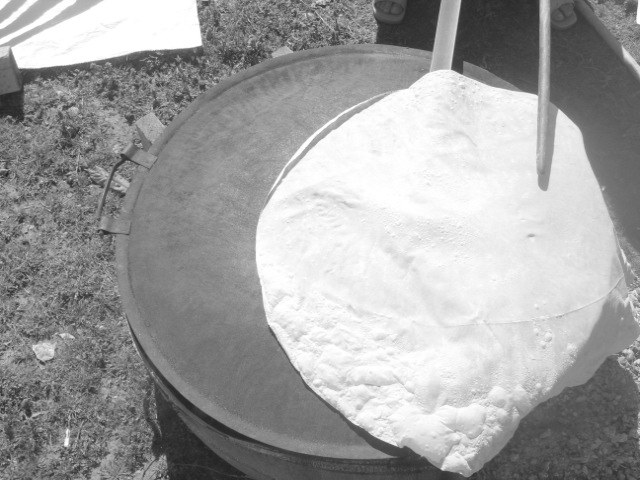
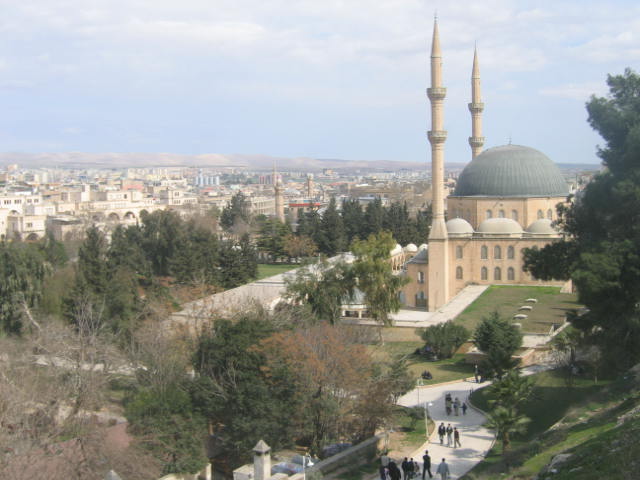
As she throws once and again the pristine white flour over the burning disc, a woman produces a bread eclipse in the village of Cedvetye, near Osmaniye. In the city of Sanliurfa, not far from honey coloured mosques, a tailor manages to put together an Argentinean flag, if I stumble upon fundamentalists, they better see I am SouthAmerican from the distance (will it help?)

Sunday, March 05, 2006

Hospitality Club members at Osmaniye (Turkey)


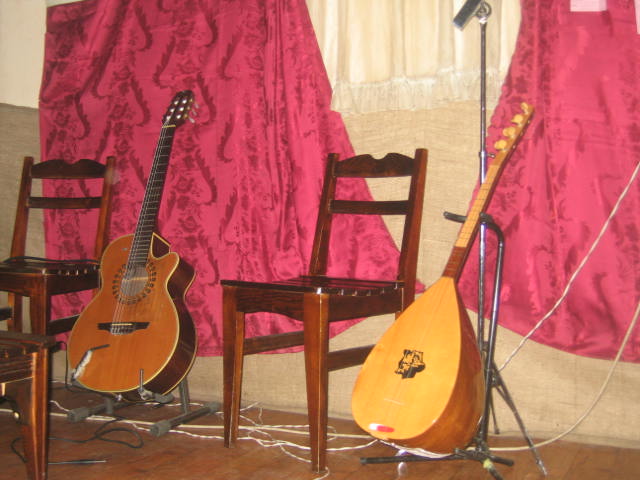
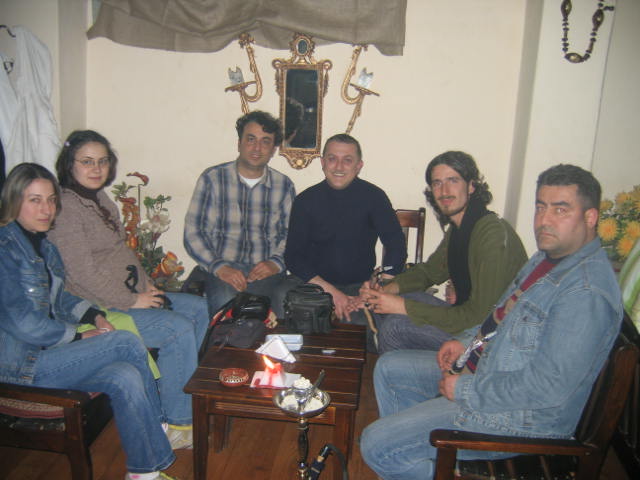
On the way to the forbidden border... enjoying the friendship of members of Hospitality Club at Osmaniye, a town that hasn't seem many members passing by. You can see in the picture; Esen, Gulsum, Erdal, Kutlu, me and Soner, in a cultural center where we listened to some cool folk music (played by Kutlu). Thanks to oall of you for your time and friendship!

Gumshoer on the way to İraq... Embassy hopping in Ankara. The hiddeous third dimension in Adana...


Photos : Crippled in front of the largest mosque in Middie (Adana, Turkey) İf İ continue like this the only world İ am gonna tour is the model at my back...

This week was a proof of how a second of stupidity can challenge months of careful study and timing. İ had made it to Ankara with the only aim of getting hand of İranian, Afghan and Pakistani visas. Having skipped winter in Egypt, in Ankara it looked like he had finally won the ‘cath me if you can game’. Being the capştal of a country normaly associated with warm weather, Ankara welcomed me with the last snows unmelted.

Obtaining 3 visas in a week is not a big deal with a bit of planning. Up to date with the orthodoxies, on the first morning İ was fast to knock the door of the Argentinşan Embassy to ask for the letters of recomendation required by the İranians and the Afghans. Excelent is not a word that covers the efficiency of the Argentinian Embassies. I only waited one hour for the 3 documents, under a portrait of San Martin, famose crew member of İnflation period banknotes and leit motiv of school children magazines.

Going around applying for tourist visas of for the ‘Axis of Evil’ is as much an experience as ıt ıs to visit those countrıes. In the desolate ıranıan embassy a bearded dıplomat scrutınızed my passport ın the search for ısraelıan entry stamps. Only afterwards (when he dıdn’t fınd any) hıs face acquired serenity, and the visa was issued on the same day. At the Afgahn Embassy my request comes as a surprise. The consul recites by heart the procedure: ‘two passport photographs, 30 USD and the letter of recomendatıon from your Embassy’. Then he takes proud of that fact that finally he has seen the day in which somebody requests a tourist visa for hşs country and states: ‘The media exagerate, very ofteen in Afghanistan you cannot hear the sound of the fighting’. He adds solemnly that Tourist Offices have been opened in Herat and Kabul.

İn the week İ had to wait for the visas I had the chance to catch a glimpse of a specific sector of the population of Ankara. And this was no doubt thanks to the converstaion with my hosts: Ant and his girlfriend Guzdan. İn a country that since the fall of the Otoman Empire has been a schism from the rest of the İslamic World, my friends belong to the most progressive handful. İn Ankara, where head scarfs are an anomaly, their fears that some windblow of history draggs the country into bear fundamentalist hands seem unjustified. Take Guzdan. Being a a professional diver (actually the first cave diver woman in Turkey) and cross country skier, she runs into panic when even considering the chance. I understand her : in countries such as Syria or İran her hobbies would be labelled ‘anti-islamic’. Where is the place for a female diver in lands where women can exit their doorstep alone only if in absolute knowledge of the way to go, implicitly outlawing leisure exploration.

The opinion cross fire between Guzdan and Bianca, Ant’s German cousin, was also notable and reflects to dıfferent phılosofıcal posıtıons, the fırst pragmatıc , the later ıdealıst. . Guzdan is eternaly grateful to Ataturk, father of the modern lay Turkısh state, to who accordin to her they own their present degree of liberty. Bianca is an a priori enemy of all thing imposed. But what if it is liberation what comes with guns and troops? İsn’t it valid at all? – is Guzdan’s question for Bianca. Then her arguing changes tactic, and she asks for the specific points of Ataturk experiment that she finds violent or negative. Bianca seemes jailed in her own definition of prıncıples: all ımposed thıngs are bad.

Bianca deserves a complete paragraph. She is a carpenter, and for 4 and a half years she has been travellıng around Europe accordıng to an old German medieval tradition called ‘wanderschaft’. In such, the apprentices of any skill abandon their hometowns and dwell for a minimun of 3 years with their skills as their only wealth. They can be distinguished for their wide hats and somewhat anachronic looking outfit. From building a yurt to reapairing a window, nothing seems to escape her possibilities of wood craftmanship.

Going back to myself, with the 3 visas in my passport, my door traspasser, my can opener.... I hit the road bound for Adana, my base in Sothern Turkey. My plan there was to leave my ıtalıan passport (and any other evıdence of my second nationality) before sneaking into İraq. I made it to Adana ın a truck at 2:56 am. It was too late to call my frıends so İ decided to camp until sunset. The petrol statıon employee, who at those hours was double checking the cash total, pointed me a building site where İ hoped to find some camping spot. İt wasn’t bad luck but stupidity: the darker tone of the surface should have tıpped me of its depth. İn free fall, half second was able to host two sensations. One was the anxiety of ıgnoring how deep İ was falling to. Almost simultaneously, the hapiness when noticing that the back pack was rotating, due to gravity or some angel, then causing me to hit the ground backwards, and absorbing al the impact. Thanks to the backpack my back resulted unharmed. My head came out with to large scratches (near the spot where my brother had slamped a door on my face when İ was 8). My left knee got the worst of the deal, and continues on strike. İ remaıned tremblıng ın the dark. Sounds like an İron Maiden song name. The terror of not knowıng ıf İ was gonna be able to stand up again was something quite unparalled. Nevertheless, it was compensated by the laugh caused by the unusual coordenate. After all, screaming for help in the bottom of an elevators gap in Adana, Turkey has some charm. More when İ thınk İ was in my way to İrak, the place where it would be more acceptable to get killed. Eventualy İ standed up, and walked as a crippled back to the petrol station where İ was collected by my friend Mustafa shortly after. My vital fluid was trickling, so I guess I looked pretty much like a zoombie straight out of an American class B movie.

Without medical insurance the doctors refused to pay any attention other than the first aid, and a radiography was needed to know what was going o in my knee. Then Mustafa enacted his dramatic skills in front of the police, to whom he demanded, for Turkey, for Ataturk, and for the Sovereignity of the Turkısh Republıc of Nothern Cyprus, to grant some assıstance. The touched policeman forced a doctor to prescribe the X ray and eventualy he just ordered me to rest. For how long? Rest!!! I can see my self, hitch hiking into İraq with clutches...

Monday, February 27, 2006

WRITING POEMS AT A PRISON IN NUWEIBA


It wasn`t my passion to drive myself off the beaten track that took me to Nuweibas's prision. It was rather a piece of experiment. When the employee of my beach campo stole 15 US dollars (3 days budget) from my bungalow, I decided to take the issue to the nearby police. Unfortunately for me, they must have had their own agreements, since they didn`t pay any attention to my problem. The said I should go the Tourist Police, that was 7 Km. away, but refused to give me a ride even if they had three pick-ups available. We argued and, guess what, the one that ended up in jail was me! Up here you can see my picture, inside Nuweiba's jail. At least I had plenty of time (one night) to give correct ending to several poems...


The ferry that I was eventually able to catch. I had my ticket when unexpectedely confined to prision. And was freed just two hours before departure!


ADANA RE-VISITED


Fotos: 1. "Sex" (real name Mehmet), a friend, and Mustafa. 2. Breakfast at Mesut's flat.

As usual, my hosts in Adan, Southern Turkey were the brothers Mustafa and Mesut, from Hospitality Club. When the bus taking me from Kilisi reached Adana it was past midnight, so I decided to call them the following morning and instead put up my tent. It would have been an easy task hadn’t been for the fact that the steep way out of the motorway here and there only met a 2 meters high fence. Felt like in a zoo. Eventually I found a gap and camped on the other side. Next morning Mesut picked me up from the carpet shop where I had been granted breakfast and phone. Already at his house, a royal style breakfast awaited, as usual!

In the two days I spent in Adana, none of the classics were missing. The BBQ in the inhospitable remote place, for example. The brothers seem to enjoy roasting a chicken or a row of fish in some remote location, behind some moutain or lake. The garden is not enough! The meal was quiet, even if some guys turned up ready to test a Magnum rifle recently bought in the black market fo 80 dollars, and started to shoot the birds over the lake. The other starring feature of Mesut and Mustafa is their drunken friends. The one I met this time was nicknamed “sex” (Mustafa says that’s because he is very good)/ After the third glass of raki Sex starts speaking fluid English, much to my surprise. Talking about surprises, another one was the news that Mustafa and his wife are waiting a new son! I finally departed to Anakara to apply for my Iranian. Pakistani and Afghan visas.

THE TRANSIT FROM EGYPT TO TURKEY. CUSTOM TALES AND HERETIC HARBOURS...


In transit from Egypt to Turkey this time it was only the mundane necessity of getting Iranian and Afghan visas that pushed my sails… The faded portraits of Syrian president Bashar Al Assad marked formally my entry in the country. Not too far from there a sign welcomes me in a way that it leaves no doubt about the democratic caliber of the country: “Welcome to Al Assad’s Syria!”. It is a wonderful morning of wet pavement and cars washed by nature. Even the old Syrian taxis Dodge Coronet (imagine a boat) had received that unjustified shine granted by bad weather to cars that left the show room 40 years ago… The custom officers seem to guess I am a kin philatelist and saturate the page of my passport with nine stamps. They partially cover each other and are obliterated by blue seal that seems designed not be read. Privilege of argentineship: visa on the border after, 20 minutes while-u-wait.


A kebab invited on the roadside by a stranger is enough to put in evidence the Syrian trade mark, in he exact moment in which the vendor, having guessed that I am the hungry one, refuses payment. Syrian trademark is Dignity. I made it to Damascus, the oldest city in the world, in the truck of a man who speaks French. That’s why he knows what autostop means… but he has never seen anybody actually hitchhiking, so proud of being able to match his learned words with reality, he sgives me the lift. In Damascus I stayed two days at Ezzat’s place. All visits to Ezzat end in teologic arguments among the smoke of the argilleh, sometimes making a break to play darts with his brother the jihadman. I was hauled out of Damascus by a 1954 De Soto several meters long, a sublime farewell ride from Syria. I thought I was going straight to Aleppo, near the Turkish border, until being given a lift by a veterinary from Tartous in a Dacia Solenza.

To decide that Tartous was worth the detour it was enough to remember that the old port was the last bastion of the Crusaders in the mainland, back in the 12th C, and also the entrance gate to the yerba mate (argentinian tea also extremely popular among Syrians) in the lugagge of repatriated expats in the 50s. Not every harbour can claim to have seen the Templar Knight going out and the yerba mate sailing in.
Thre is something in which Tartous resembles any other port in the world. As al ports, it manages to oversee the rules, attenuate dogmatisms, lighten clothing and mixing religions. Few women near the beach are happy to wear a scarf over their heads when the temperature in summer goes over 40. The same, shall somebody attempt to explain Tartous seamen, who sail the seven seas, that the beer is anti-islamic. In a country where transgression is seldom forgiven, the tolerance to transgression is transgression itself. It was those seamen who spot me wandering the streets in search of a roof and invited me in their place to share some whisky. One of them had worked on board an Hondurian ship and spoke Spanish. Not need to say, they hosted me, and the following morning I was of northwards as fast a control remote toy car. The destination: Adana, in Southern Turkey, distant 630 kms from Tartous. I was quite sure of being in for a two days trip, since I only stepped in the road at 11 am. Nevertheless, half an hour later I had found a family from tartous driving their Corolla to Aleppo, that’s 50 kms from the Turkish border. As the decisive ride can happen in any moment, I follow the procedure, change the remaining Syrian back to dollars, and turn the unchangeable coins into eatable items (loads of cheap flavourless biscuits) including half kilo o yerba mate, which God knows when I am gonna find again on the shelves.


It is already night when I reach the border. When the Syrian custom staff sees me in, they ask me where did I leave my bike. No bike, I explain, I am on foot, and I come from Argentina. It should be written down and archived for posterity that the rankless soldiers in the Turkish-Syrian border prefers “Taragui” yerba to the Amanda one. On the Turkish side the soldiers hold machine guns that at least have triggers, and they gossip about the fun they have when duty allows them to open fire over the heads of Syrian tea and sugar smugglers. As the no one’s land between the two countries they put in a taxi bound for Kilisi, the first Turkish city. Quite predictably. The taxi driver makes his attempt of extortion, and asks for 20 bucks not to let me stranded. In that moment, and corroborating Chomsky’s theories about generative grammar, I discover that my arabic is good enough to say: “Allah is bigger than you” (“Allah is bigger” alone is the phrase which is spit by the minarets of all the world at prayer time, so I just added the final “than you”). The result shows that, unlikely the Egyptians, who can sell their God and their soul for a phone token, the Syrians are ready to loose money in order to preserve their dignity. So the cab driver runs behind me begging me to go back to the car. So the way to Kilisi included this little dramatic play in the middle of the road.
.
From there to Adana it was another 200 kms. At 9 pm, pretty much impossible mission. But then, and even if the Turkish soldiers had warned me about how a hellish place Kilisi was, the first man I ask about the road to Gaziantep is a Kurd who sponsors my bus trip to Gaziantep. A further lucky strike occurs when I discover that the bus goes actually all the way to Ankara via Adana. The driver has no objection with me staying in, ticketless. I made it to Adana past midnight, too late to phone my HC friend Mesut. Some sleepless neighbor may have notice the low blue tent not far from the motorway.

Saturday, February 25, 2006

SIWA: THE GLOBALIZED SANDS.


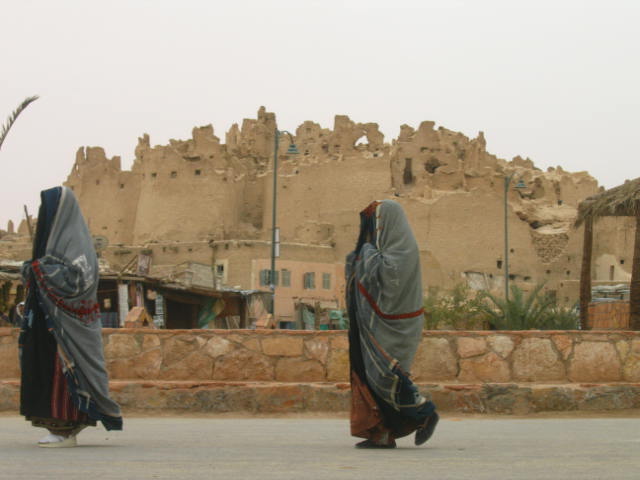
Photos: 1 and 2: siwi women. 3. Mechanical problems in the Sahara.

Many years ago, when the circular tables of the Coratazar Cultural Center at Mar del Plata were circular and centered as petals boiling mind travelers craving to hit the road, any road, then Viqui would say that routine is as sad as a physic map of la Pampa Province. When I started walking south from the Mediterranean city of Marsa Matrouh to Siwa Oasis, inmersed 300 kms in the Sahara desert, I couldn’t less than remember Viqui’s metaphor: the desert is so featureless that the map is all whitness and quadrants organizers of the most absolute nothingness. A red line challenges that void: it’s the road that the government built in 1984 to abreviate to a 4 hours drive what used to be a week long camel trek. Alexander the Great, on his way along the same path to visit the Oracle of Amun in Siwa and confirm his sinship of Zeus, took 8 days for his trip, which according to history was rather uneventful, with the rulers of neighboring Cyrene (present day Lybia) sending him war horses as a present intended to show sympathy and discourage an attack from his behalf.

Exiting Matrouh, evidences of mankind reduce gradually until the Sahara gains all its magnitude. A quarry 40 kms away and some oil fields ahead allow for some traffic and gives pulse to the road. 20 minutes after I set off a quarry bound truck beats the roadside and lifts me. Its driver makes it clear from the beginning that here we are bedouins, in Cairo they are arabs. The next driver were also going to prove good examples of local mind. It was a pick up carrying two sheep, and the drivers were interested in knowing two things: first, if there was rain in my country; second, if there were arabs… The answer: (with rain and without arabs) let him shocked in awe and wondering the requeriments for a visa… It is also interesting to note that, while the bedouins themselves are ethnically arabs, they use the label arab to refer to the settled ones, in opposition to their semi nomadism.

Eaten away the last sandwich, I was only hoping to anchor my tiredness in some inhabited place… A tank truck forward me until the oil fields, where some angel had opened a tea house, where I could buy provisions. The tea house itself is a cubic structure outside which the owner (the angel) smokes shisha. One of the walls calls my attention, there is a giant graffitti of a Nokia mobile phone with realistic details of each numeral key. “Do you sell telephones?” – I asked surprised. No as an answer. I looked inside: biscuits, some bread, tea, final stop. The mural is just decoration, altough I would risk considering it a sort of amulet , icon of the prosper West, an almost magic artifact. The mobile phone is a clear example of the irrational pattern of globalization. The devices have arrived here more as a mandate than as an option, and are seen in hands of people and farmers who should have other priorities. At night the oil digs cheer up in light as tiny Eiffel Towers. I travel now in another truck, we horn to clear the road of camels… In Bir-el-Nuss, a well to which modernity has added a restaurant, I am allowed to sleep. It is midway.

During the morning I make an attempt (failed) to reach Qara Oasis, extremely isolated, 100 kms away from Bir-el-Nuss, which is already in the middle of nowhere. But I am asked for militar permits. Then I continue on to Siwa, contemplating with envy the nylon bags, the only beings to transit freely without documents and at full speed towards Qara. I start to note that I am not Alexander the Great: the Libyans didn’t come to offer me their war horses, and the two crows that showed the good way to Alexander (according to his yellow press paid court poets) must be guiding genuine emperors-to-be. After an hour of walking, and matching the context, a Land Rover stops. A man from Cairo who is building a hotel in Siwa. After a while the Lan Rover starts puffing, sand in the oil bomb, which we dismanteled with the aid of my MSR kitchen tool. As a result we reach Siwa by night.

If asked to describe Siwa, I shuld say that nothing I imagine can resemble more a miracle. After 300 kms of plain desert, of compact emptiness, it is hard to believe my eyes: for kilometers the palm trees don’t leave patch of sand at sight, only interrumtpes by two large blue lakes. On the streets the disbelief rises: people speak not arabic but siwi, a local bereber language. The people don’t look after any other I have ever since, and the are a synthesis of all the peoples that have roamed in the area: algerian bedouins, black people from Sudan, and arabs. Their skin is dark, their forehead high and broad, and finely curly hair. In top of that, one family is composed by blond blue eyed individuals…
Since the construction of the road-umbilical string, Siwa seems doomed to resign slowly its cultural uniqueness in favour of the Nokia and the moods of Cairo, Arabic has replaced Siwi at schools, and tourism rises as a kind of reparation prize, while the government forces the bedouins at neighboring Abu Shrouf village to leave their tents and move to houses. The siwans, however, promise to offer some resistance in this wrestling contest with the global village… Siwa continues to be a highly conservative townn and the few women who venture to the streets covere themselves from head to toe. Often they move in groups, over donkey drown karts. More than women they seem an apparition. The population continues to be divided in 11 tribes, and any new resident must suscribe one fo them. Regardless its curious mix of tradition and change, Siwa can praise itself of being, of all the place he could choose between, the spot where Alexander the Great demanded to be buried. With the sun falling behind the Oracle of Amun, I can consider the trip succesful. Bah… there is not such a thing as a failed trip: each step under the sun is unique and beautiful.

FOLLOWING ALEXANDER THE GREAT’S TREK, AND STUMBLING ON THE WAY.


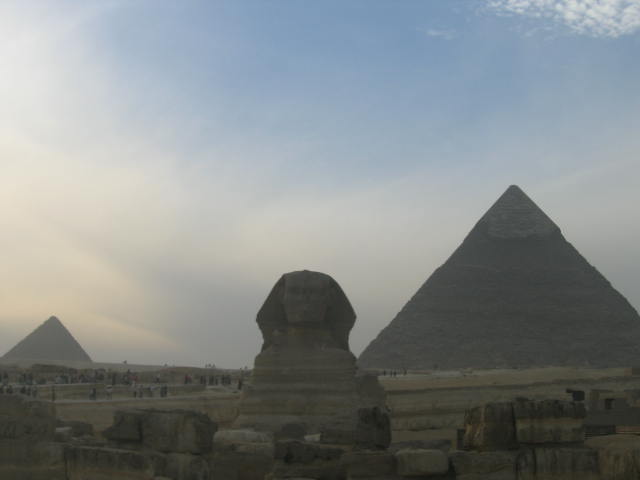
Photos: 1. Pyramids. 2. Kids at SOS Children Village at Al Amria Suburb. 3. Magdy and his cusin, guardians of El Alamein German Militar Cemetery.

The difference is great. Between Alexander the Great and me, I mean. He counted with a 50.000 men strong army. I am alone and traveling by thumb. He strived to forge an empire, I like them only when they crumble down. Maybe motivated by the unoble ambition of having something in common with the Macedonian Star it was that I put the finger on the map over Siwa for the first time. At least this way we would have a route in common. Siwa is an oasis emerging against all possible forecast 300 kms south of the Mediterranean Coast into the sands of the Sahara Desert, not far from the Lybian border. It always owed its fame to being the site of one of the most famous oracles of the Ancient World: the Oracle of Amun, that was believed by the Greeks to be a local manifestation of Zeus. Having taken Egypt from the Persians without fighting, Alexander marched from Memphis magnetized by the fame of the Oracle, anxious to legitimate his sonship of Zeus.

When I left Cairo, the adventure had an operistic oberture when I discovered that the road to Alexandria boasts in its western side not less than the Pyramids. The road to Iskendereia (one feels in the Classic Age when using the local label) was anything but average. First my wallet with 100 dolars was stolen by some impoverished mummy, leaving me with mere 20 cents and 220 kms ahead. 1-0 for Alexander. In such humiliating circumstances a Daewoo stops after only 15 minutes waiting. The driver was a man in his early sixties, spotlessly dress in a suit, while her companion was a woman: 40 years younger than him, thick lips, dark skin and a blue hejab covering her hair. Then the man, becaming a strange statistic case for my road notes, offers me the lady with the only condition of having preferential seat. That’s what I calll to receive 1000 spoons when you need a fork, and it’s only another example (gay truck drivers, etc) of those choices that, repressed by a police force that applies the Qoran, only finds decompression in sealed private spaces and with foreigners. Anyway, 1-1.

On the first night I was hosted and fed by two watchmen that would jump out of their bed with a loaded gun at the minimum noise. On the morning a taxi driver accepted to take me for free to Alexandria, strange event in a country where somebody seems to have swap the Quran for Adam Smiths’s books. “Why not money?” –the man cried and bumped the wheel with his head. He droped me in the suburb of Al Amria. 30 kms from the center. There, a woman that steps down from a motorcycle taxi guides me without my request to a branch of SOS Children Villages. All without words, as obeying a secret choreography of destiny. She is one of the mothers that literally consagrate their lives to raise and educate orphans, from KG to University. She makes me visit each of the houses, 75 children in total. After the visit I could readily say that the village is truly an isle of sanity in the middle the urban chaos that pervades the rest of the suburb, where children work in the vegetable market that smells to donkey’s flatulence.

When I reached the center of Alexandria –in the car of a manager that payed my hotel night-. Looking around I was assaulted by the impression of having been there for ever. I would have never imagined that Alexandria resembled so much Mar del Plata (my city in Argentina). With french style architecture lined against the seaside boulevard conveniently named corniche, horse carriages and cafes that mix in their menu british ale with greek food, Alexandria has allowed the belle epoche a passage to modernity. What reaches the present is an hybrid: elaborated iron street lamps and trams shake hands with shisha bars and local fishermen that knee over the sand at prayer times. The number of foreign consulates in the city attests to its cosmopolitan history, but it also makes you wonder in what does the Slovakian consulate use their time…

When Alexander arrived here he found reportedly a tiny fishing village calle Rhacotis. Over that embrio he ordered the foundation of a big city that would bear his name and would become the greatest center of culture of the Classical World, with the famous Alexandrian Library as its centerpiece, which is said to have contained 500,000 scrolls. In its rooms Euclides proposed his geometry and the circumference of the Earth was first calculated. In the 4th C. the Library was burnt down, in the name of Christianity. Egyptian Authority needed 1700 years before erecting a substitute. The fact that it was inaugurated in 2001 under the government of the dictator –still in power- Mubarak. Also nowadays Egypt just seems the last place on Earth that could natural produce such an offsrping as the replacement fot the famed library. (The average Egyptian cannot read a map) The new library is, in any case, an esthetic triumph: its glassed surface projects a beam of light, including the other local legend, the Lighthouse of Alexandria, which rated among the Seven Wonders of the Old World.

From Alexandria, the way to Siwa. Distant some 600 kms, is made in an “L” movement, as the horse in the chess. It ‘s 300 kms to the west along the Mediterranean Coast until Marsah Matrouh, where the Afrika Korps had their base during WWII. I travel first in a Toyota Corolla of a Egyptian Christian residing in Italy, who presents me a kilo of dates an a weird sacred oil that –he assures- will protect me from the wolves of the desert. The fiirst day I only covered 100 kms, arriving by night to the German at El Alamein, where 4200 soldiers rest. As said by Albert Schweitzer: “There is not a better argument for peace that the tomb of a soldier”. Magdy, member of the bedouin family that guards the mausoleum, allows me to camp outside its walls. The we trade: he offers me bread and cheese and I write a letter in English to somebody called Jean Lucqe in France. Then he asks me why I don’t believe in God. He is brave enough and goes on with an analogy: “If there are 10 people and 8 tell you that certain place is dangerous, do you believe them?” Ontology by consensus, a bedouin masterpiece. I remind him that the 4200 soldiers behind us were also obeying a majority, not to talk about the terror that threads consensus, not to talk aboout Mubarak, the new Faraon of Egypt… The next day I made it to Marsah Matrouh.

Friday, February 24, 2006

CAIRO: NEW YEAR'S EVE IN A 1960 FIAT. "LITHUANIA? WHAT PART OF THE UNIVERSE IS THAT?


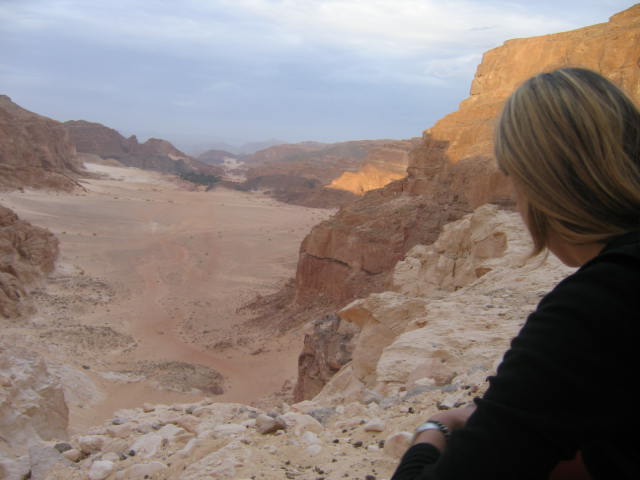
Photos. 1. Pyramids. 2. Ain Hudra Oasis appears suddenly beyond a rocky hill. 3. Unexpected New Year’s Eve with our taxi driver.

Nthe number 400 seemed to much of a superlative to designate the tattered, rusty, shaky bus that was delivering me to Cairo International Airport, where Sigita’s plane would land at 2:10. At the sight of a foreigner in the bus, the ticketman chopped the 25 piastra ticket off with a mix of pride and skepticism. Asked if the bus was going in fact to the airport, the same man raised his hands to heaven and exclaimed: “Imashallah!” (God wanting), which shows how in the Middle East the idea of God is intimately interwoven with lapses of random efficiency.

No less than bus number 400, the way in which Sigita and I had met leads to the search of the threads beyond the puppet, and makes one wonder if things happen for a reason or simply happen. It was an afternoon of the last August. I had crossed that morning the Lithuanian border from Latvia, by hitchhiking as usual, and in the moment I walked along the Green Bridge, the sign bearing the phrase “Aplink Pasauli” was still hanging from my backpack. Admiring the peculiar contrast between the soviet style hammer-in-hand worker ornamenting the gate of the bridge and the towers of the newly built Europa Center behind, I had almost forgotten I was after a supermarket. Sigita was also crossing the bridge on foot, due to a mechanic failure of her Mazda, with the lazy pace that all visit to the dentist should inspire in normal people. Our eyes met for the first time over the question: where is the supermarket?” Now, an old taxi that reproduced with fidelity the sound of an oil generator was driving us to the infamous 2-dollars-a-night pension. In the ground floor of the fin de secle building, a wooden elevator that may have once accomodated french speaking aristocracies now lifted and landed glossy eyed penniless backpackers.

Our room seemed straight out of a Dostoievsky novel. And I say it with all the tenderness that I feel when confronted with sheets where the cigarette holes form constelations. Sigi downed her backpack and started to unpack. It seemed logic to me that the first thing to come out was a bag with fish. The second was a Polish map of Egypt and the third a complete make up set. When her succesful career as graphic designer is not keeping her busy, Sigi ocassionaly poses for the camara. I almost don’t believe her when she says that there are now posters with her picture in downtown Vilnius. That the girl-in-the-picture was gonna end hitchhiking in roads side by side with camel and donkey karts is something that the man-in-the-corner at Vilnius surely ignores. But nothing new for Sigi, who until the age of 12 used to accompany his father –journalist- in his trips around the ex USSR.

In any case, some adjustments needed be made. The fact that our first walk would take place in the most conservative area of Cairo –the Old City- didn’t seem to attenuate the cosmetic powers of Sigi’s make up set. As she was getting prettier with every second, I didn’t have the courage to halt such a promising process with the mundane proposition of: “Hey! This is an islamic country!”. The result was –of course- in the jammed alleys of the bazaar, a massive abandon of Qoran by vendors who lost control of their jaws to exclaim a lascive: “Welcome to Egypt!”. Next time, Sigi rolled a scarf round her neck.

And when is this guy start to talk about the Pyramids? It was an Arabic scholar who said: “All things fear time, but time fear the Pyramids”. We all have a timeless mental image of them, in solemn rest amid endless sands. As a result it comes as a surprise to discover that the Sphynx actually faces the 15 million souls megalopolis. How many millons were born, sweated, and died in front of her eyes? We all should have a Sphynx in our garden to remember the importance of the fugitive moment.

New Year’s Eve took place in a Chinese restaurant. On the way back, our taxi driver could only hit the right address of our hotel after one hour. So at midnight we were opening our cans of Stella in the back seat of a 1960 Fiat, while our drive shoutted out the name of our hotel to passers by with the hope somebody would give him a hint.

Next day we set off for the Sinai, where we started to hitch hike, passing on foot the Egyptian police check points. While hitch hiking in Egypt is in theory illegal, nobody can stop those who declare to be traveling on foot. When the officials read “Lietuvos Pasas” in Sigi’s passport, they ask what part of the universe is that. Somebody with a machine gun suggests that it is a part of Russia.For Sigi, whose parents lived closely the events of January 13, that is pretty much an insult. “Thanks God you are not from Kaliningrad” – I tell her. When my time comes and I say Argentina, the guys recite a list of football players. Diego has become a sort of password. All the same they let us through. Each time. We then visited the sea side paradises of Dahab and Tarabin, where Sigi would say, in a full demostration of Baltic character, that fish, colourful or not, are to eat and not to see behind a diving mask. On the way back to Cairo we crossed the inner desert of Sinai, many times sharing the truck cabin with egyptian workers hitchiking themselves. We stay overnight in Ain Hudra Oasis, where false beduins dedicated to tourism approach us to sell camel rides, while their daughters spy the West trough the shortcut of Sigi’s cosmopolitan magazine.

On January 9th a plane took off from Cairo Intl Airport. Sigi was inside. Time for me to start to investigate how to get iraqi, iranian, pakistani and afghan visas…